Autumn Essay 2026
What Falls and What Remains
Autumn bowled in suddenly in Aberdeenshire. One minute I was harvesting courgettes and the next, the trees were dropping hundreds of apples like cartoon bombs. Damp mornings. Smoke returning to the air, but not this year, the distinctive peat smoke of the islands, more wood smoke or the unusual smell of smokeless ovoids, here. Leaves gathering themselves into corners and drains. Light changing before anything else, longer and longer nights and howling gales of hilarious severity, threatening to whisk the Polytunnel cover to the Faroe Islands.
Light shining out from the neighbour’s windows, smoke drifting from chimneys, carefully monitoring weather apps for incoming storms. There’s a sense of instability, that anything could happen. In the Port of Ness, ‘are the boys back?’ and curtains tremble in anticipation of boiling guga and how many months of open windows it will take for the aroma to release. Usually. Not this year, though, as NatureScot did not issue the Men of Ness a license.
I have come to think of autumn as a season of carrying. We gather and preserve and process and learn what sustains us. I wonder if the body understands autumn before the mind does. A slowness, gathering inward. A subtle reorganisation of pace and attention.
In recent years, particularly through experiences alongside ageing and menopause, I have found myself becoming more aware of what helps me to remain anchored during periods of transition and uncertainty. Probably not in enormous transformative ways, but through ordinary life tasks and sensory familiarity.
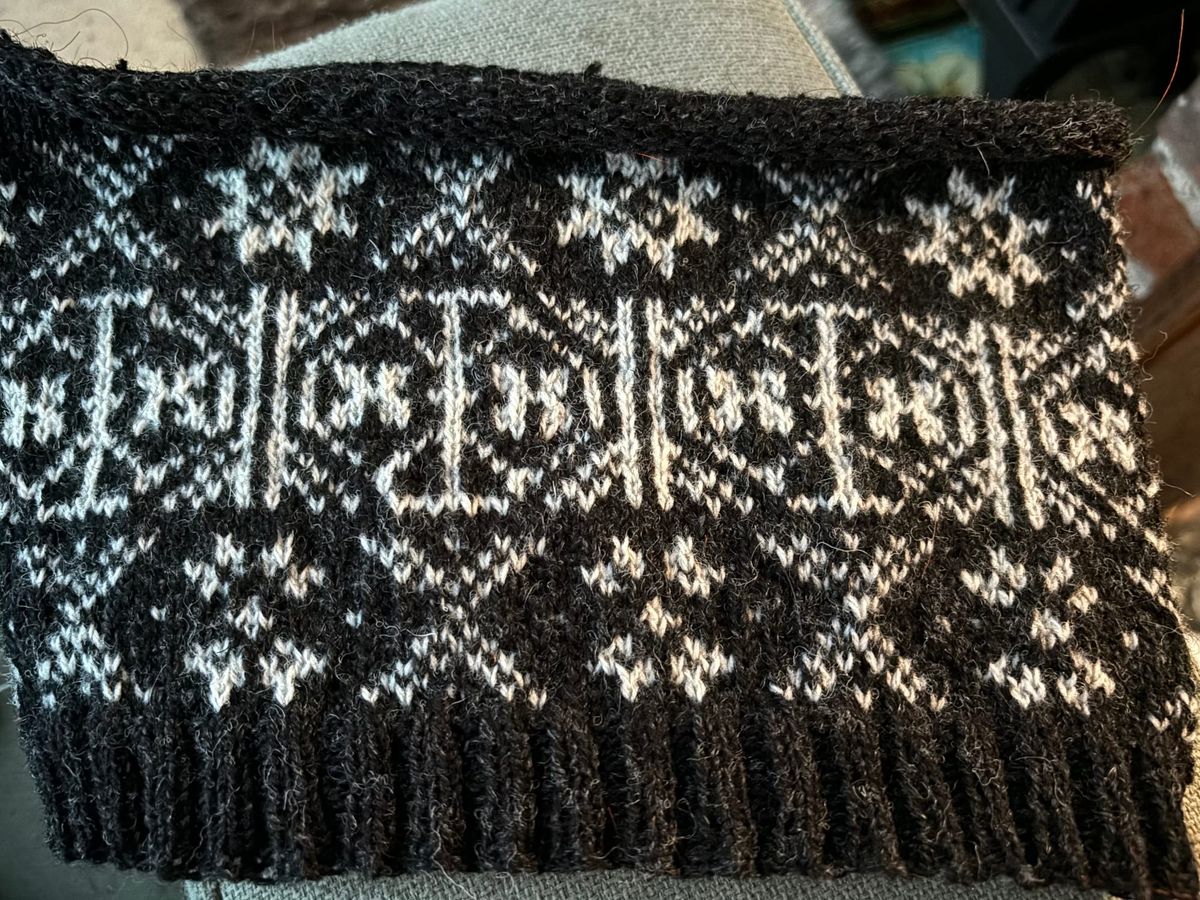
I knit, walk familiar paths, stir soup, fold the dry washing. A repetitive click of needles through wool in firelight, while evenings draw in earlier around the house. There is something reassuring about movements the body already knows. And these movements don’t need to be productive in the way today’s culture seems to celebrate, but grounding, meditative, regulating and rhythmic movement.
I wonder whether some forms of making and repetitive hand activity help us remain emotionally and physically steady during periods of bodily and cognitive change. I wonder if embodied activities are not separate from communication at all, but forms of language in themselves.
One stitch after another, autumn following summer, following spring. Progress through continuation, rather than speed. I sometimes wonder if women might have always known this.
I also wonder if, long before therapeutic terminology and wellbeing frameworks, women knitted, sewed, stirred, peeled, preserved, gardened, darned and repeated familiar movements through grief, uncertainty, waiting, poverty, pregnancy, ageing and exhaustion.
These activities wouldn’t have solved life’s problems but they might have helped carry people through it. I wonder if so much of this labour remains culturally invisible because it is repetitive, domestic, feminised or quiet.
I circle around the question - what kinds of lives and ways of knowing are allowed to count? I think that this question has followed me through much of my working life, too.
One of the things I noticed repeatedly in the islands was that certain foods seemed to carry far more than nutrition. They carried stories, seasons, places and relationships.
Every year, towards the end of August, conversations would begin to circle around guga. Not debates about it, but questions. Were the boys back yet? Who had gone this year? People spoke about the journey to Sula Sgeir with a mixture of pride, worry and humour. The guga itself seemed secondary to the relationships, memories and seasonal rhythms surrounding it.
I was fascinated by this because I kept encountering similar patterns elsewhere. A woman longing for herring fried in oatmeal. Someone else desperate for a slice of black pudding with a poached egg. The annual anticipation of a strùthan. Duff made exactly the way a mother or grandmother had made it. Foods that seemed to announce a season had arrived or that a place still existed somewhere within reach.
Working alongside older people, I became curious about what food was carrying. Sometimes a request appeared simple on the surface but seemed to contain much more beneath it. A taste might evoke a landscape, a family kitchen, a fishing season, a childhood memory, a way of life or a sense of belonging. Food often appeared to function as a form of cultural memory, held not in archives or museums but in hands, recipes, aromas and shared meals.
At one point, I met with a head office team from a large care organisation to discuss food and culture. I arrived full of stories about local foods, seasonal traditions and the emotional significance people attached to them. The conversation quickly became one of procurement systems, approved suppliers and organisational policy. Nobody was being malicious. The systems existed for understandable reasons. Yet I left thinking about how difficult it can be for institutions to recognise the things that matter most precisely because they are so ordinary.
A plate of food can look deceptively simple. A slice of black pudding is never only a slice of black pudding. Everyone seems to know if it’s a Charlie Barley’s black pudding. Herring fried in oatmeal is never only herring. Guga is never only guga. They can carry seasons, identities, memories, places and people alongside them.
I think this is partly why food memories linger. They remind me that people do not live by nutrition alone. We live through stories, rituals, anticipation, relationships and belonging. We anchor ourselves through repeated acts that connect us to other people and to places we love.
Maybe that is why certain foods matter so much. Not because they are rare or special, but because they allow people to continue participating in their own stories. And maybe participation, more than preservation, is what keeps culture alive.
For many years I worked in care management and later within dementia projects and co-production work. Now, I realise that one reason I often feel resistant to simple narratives around care, systems or social policy is because I have spent too long sitting inside the human consequences of decisions.
People might speak about budgets, thresholds, reviews and policy as though they exist as abstract concepts. But eventually every policy lands in somebody’s kitchen. Maybe in somebody’s body or their family. That becomes a very sobering thought.
I never welcomed the power attached to care management. I experienced it less as authority and more as responsibility. Public duty and service. Stewardship. The uncomfortable awareness that decisions made in offices could alter the shape of somebody’s daily life immensely. And often I felt that there was no entirely good answer available. Only different kinds of harm to weigh against one another.
If I increased a care package, would it later be rejected by panel? If support was agreed this year, would another worker need to remove it next year? Was I creating temporary stability or future distress? What level of risk was acceptable in pursuit of a meaningful life? What happened to children while a parent recovered? What happened to exhausted carers while systems debated thresholds?
I remember receiving a speeding ticket while driving people home after a bowling trip. Even writing that sentence now makes me wince slightly.
The outing had been a success. People enjoyed themselves. We were heading home with medication times, meals and routines weighing on my mind. As anyone who has worked in care knows, a seemingly simple outing carries an enormous amount of invisible planning and responsibility.
Then suddenly there was a man in black standing in the road with a speed gun.
I was completely taken aback.
Was I speeding?
I genuinely couldn’t believe it.
The road seemed to alternate endlessly between 60 and 40 mile an hour limits and somewhere along the way I had failed to register the latest change.
“Park up, get out of the vehicle and hand me your keys, madam.”
So I did.
At the time I felt mortified. I had a vehicle full of vulnerable people and a growing sense that I had failed at the very thing I was trying hardest to do - get everybody home safely.
Looking back, the thing that floats to the top is not the speeding ticket but the collision of competing responsibilities.
The bowling trip mattered, so did getting people home on time. Medication mattered. Food mattered. Safety mattered. It all mattered. Participation, independence, community, getting out in familiar landscapes.
The speeding ticket was real and so was the value of the outing.
Neither truth cancels out the other.
Maybe this is one reason I am wary of simple conclusions. Human situations rarely offer themselves as straightforward choices between right and wrong. More often they involve several important things existing simultaneously and refusing to arrange themselves neatly into a hierarchy.
At the time, all I could see was my mistake. Now I also see everything I was trying to carry.
I wonder if people sometimes imagine care decisions as clean cut exercises of professional authority but in reality they often felt more like carrying multiple fragile futures simultaneously and trying to choose the least harmful path through them. The least worst option.
Perhaps this is partly why I remain cautious about certainty now. Once you have worked alongside real challenges in real lives, easy conclusions begin to feel less convincing. At the same time, I do not want to romanticise complexity either. Harm exists and so do poor decisions. Systems fail people And power can absolutely be misused.
And yet I think that humans also consistently exceed the categories we construct around them. This feels very autumnal to me. Earlier in life, I think I wanted clearer distinctions between good and bad, ethical and unethical, helpful and harmful. Lately, the closer I get to people’s lives, the more I realise how much can sit together at once.
I suspect that people are never singular. The same person can be grieving and hopeful. Generous and exhausted. Wise and mistaken. Capable and struggling. Sometimes all before lunch. Maybe one of the difficulties with diagnoses, job titles, social categories and professional descriptions is not that they are entirely wrong, but that they are almost always incomplete.
I remember chatting with a man in a care home who had been described to me as someone who liked bikes. Over time, through gestures, facial expressions, pointing and the handful of words available to him, he patiently communicated something that felt much larger than the conversation itself.
“Oh, they told you I liked bikes, did they?”
There was a definite eye roll involved.
Yes, he liked bikes. But bikes were also connected to why he was living there. He liked cars too. He wanted to talk about cars. He wanted to talk about lots of things.
What he seemed to be communicating to me was not really about bikes at all. It was that he was more than the summary. He was more than the information passed from one person to another. More than the handful of details that had survived into care notes and introductions.
For goodness sake. I’m not the bike man.
The longer I spend alongside people, the more aware I become that most of us are carrying versions of one another which are useful but incomplete. Why do we reduce each other to professions, diagnoses, interests, achievements, mistakes, political views, family roles and social identities? Because complexity is difficult to carry? And yet people consistently exceed those descriptions. Perhaps one of the great privileges of spending time alongside people is occasionally catching sight of everything that escapes these summaries. This applies far beyond dementia.
I have never fitted especially neatly into categories, myself. Depending on who is introducing me I might be described as a care manager, a project co-ordinator, a facilitator, a gardener, a knitter or any number of other things. None of those descriptions are wrong. None of them are complete either. The same, I’m sure, is true of all of us.
I wonder whether one consequence of ageing is becoming less certain that we ever fully understand another person. I don’t believe that understanding becomes impossible, but we gradually realise how much remains outside of our reach. The closer I get to people, the more aware I become that I know fragments, moments, conversations, shared experiences. I know how these moments changed my own thinking. But I do not possess somebody else’s whole story.
This might be one reason I have become increasingly cautious about certainty. I used to think that paying close attention would eventually allow me to arrive at complete understanding. Now I am not so sure. What I find instead is layer after layer.
The actor whose intentions I misunderstood during a Curious Shoes performance, for example. A wonderful lady got up and joined in with the performance and one of the actors froze in position and looked around the room. At the time, I thought ‘oh my goodness, what now?’ but he just continued, weaving the new cast member into the story as though she had always belonged. And it was only afterwards that I realised that the actor had been performing to the audience, giving us cues as to how to feel about it. He was plenty experienced and skilled enough to handle the situation, he was just allowing the moment to bloom. I felt quite humbled at my initial misinterpretation.
The colleague whose actions made more sense years later than they did at the time. The friend whose public achievements reveal only a fraction of the effort required to sustain them. I realise that earlier versions of me only partially understood what they were seeing.
The community, arts and dementia work was only possible because so many people cared about it. Artists, researchers, funders, care staff, campaigners, managers, volunteers, family members, community groups and colleagues all brought something I could not have brought alone. Their skills, priorities and ways of seeing often differed from my own. Sometimes those differences created tension, not necessarily around me but between each other. Sometimes they created opportunities. Usually they created both.
At the time, I often found myself trying to reconcile competing priorities. What mattered enormously to one person could seem far less important to somebody else. I did not always understand why people cared so deeply about certain things, just as they may not always have understood why I cared so deeply about others.
Looking back now, I am struck by how much of that was shaped by where we happened to be standing. Not only professionally, but personally. We meet people at particular moments in their lives. We encounter them carrying the experiences, responsibilities, ambitions, worries and certainties they have at that point in time. We rarely get to meet the person they were ten years earlier, or the person they will become ten years later.
I sometimes wonder what those colleagues would make of their younger selves now. Then I find myself asking the same question of my own. The Paula who arrived in the islands brought energy, humour and a determination to make things happen. She could navigate situations that would probably exhaust me now. The Paula writing this essay brings different things. More questions. More uncertainty. Perhaps a little more patience with complexity. Neither version sees the whole picture. Perhaps none of us ever do.
Instead, we meet one another briefly along the way, each trying to make sense of the world from where we happen to be standing. Autumn might increasingly consist of these moments. Discovering the limits of certainty. Not understanding people completely, but becoming more respectful of everything that remains unknowable.
In addiction services, I met people with extraordinary intelligence, organisational ability, social navigation skills and memory. I did not and do not condone the harm involved in drug dealing or exploitation, but I often found myself noticing (perhaps being quietly impressed by?) the immense capability and varied skillsets present within people whose lives were publicly framed only through deficit and dysfunction.
Again, what kinds of intelligence are recognised socially? Which forms of labour count? Who gets described as valuable?
I suspect these questions are partly why co-production work within dementia communities affected me so deeply too.
Some of the most thoughtful policymaking and ethical reflection I have encountered emerged through co-produced dementia work. I have seen people living with dementia reshape professional thinking, challenge assumptions, influence research and alter the emotional language surrounding diagnosis and care. And yet I have also watched facilitators holding emotionally overwhelmed online meetings together by the skin of their teeth while participants left distressed and exhausted. At times, I was that facilitator.
I have seen unpaid labour sustaining projects publicly described as inclusive and empowering. I have seen brilliant academics trying sincerely to work ethically inside systems which still reward publication, outputs and institutional recognition more visibly than emotional and relational labour.
I do think that genuinely shared human participation is much messier and more demanding than polished conference language sometimes allows.
There are people quietly holding rooms together all over academia and care work. Facilitators, collaborators, family members, people staying behind after meetings to support somebody in distress. People carrying invisible emotional labour beneath visible projects. Often, I find, the labour becomes difficult to recognise because it is bound up in relationships rather than measurable.
I think of my friend James, who has now lived for many years following a dementia diagnosis and still continues showing up week after week in online meetings and discussions. He has received recognition, including an honorary doctorate and an MBE, and rightly so. But what strikes me most is not the prestige itself. It is the continuation, his sustained generosity. The ongoing willingness to participate, contribute, think, advocate and support others despite the enormous effort this must require.
I wonder about the generosity involved in people living with progressive conditions continuing to contribute towards futures they themselves may never fully inhabit. Showing up repeatedly while time must feel precious and uncertain is no small thing.
I think about my friend Martin, and I don’t think he will mind me saying that I have noticed the immensely challenging emotional rollercoaster that he goes through while tackling academic projects.
I think about my friend Agnes and the way she describes the forming of the group the Scottish Dementia Alumni at a point when one campaigning era appeared to close and another one was opened. New campaigners come along but this long lived wisdom of lived experience still needed an outlet. And is still immensely valuable in its longevity.
Perhaps this too belongs in autumn. The awareness that continuation itself can become a form of contribution. Not all flourishing appears expansive. I think that flourishing also happens through endurance, adaptation and repeated participation.
Recently, I have found myself thinking seasonally about my own life too. Spring Paula still had so much to learn and had not yet fully found her place in the world. She also had toddlers to run after and a career in its infancy.
Summer Paula was so busy caring, mothering teenagers, supporting family, working within difficult systems and completing a degree that she barely had time to stop moving long enough to think.
Autumn Paula has more time for noticing. More time for gardens and village conversations over gates. More time to sit with uncertainty. More time to realise she may have misunderstood things previously. More time to reconsider old certainties.
None of these versions are better or worse than one another. They are ecologies with different conditions And I don’t think that I’m just being kind to myself in that. I believe it as a theme of human flourishing.
Perhaps people do not inhabit static states at all, but shifting ecosystems of changing capacities, priorities, freedoms, responsibilities, losses and forms of participation.
I increasingly resist cultural expectations that human value should remain tied to productivity, speed, certainty or professional achievement. Autumn has made me more aware of many forms of intelligence. Practical intelligence. Relationship intelligence. Adaptive intelligence. Embodied intelligence. Emotional intelligence (I’m aware that I write a lot of lists - my thoughts can be quite densely populated).
The kind of intelligence that notices weather changing before rain comes. The kind that knows when soup needs more chilli without measuring. The kind that remembers all of the family birthdays. The kind that keeps households and communities functioning. Maybe autumn also allows more room for reinterpretation.
I often think about that Curious Shoes performance. At the time, I thought the actor froze in surprise and was wondering what to do. Afterwards I realised I had entirely misunderstood what was happening. The performance was not about artistic realism. It was relationship scaffolding. Emotional signalling. A way of helping audiences know how to participate together. He had stopped, frozen for a comedic moment to involve the audience and then he continued to include the new ‘cast member’ joyfully. I had missed his skilful structuring of the moment, initially.
I think autumn increasingly consists of these moments - realising earlier versions of yourself only partially understood what they were seeing. I could probably write an entire essay composed solely of things I later reconsidered.
I remember at the outset of co-ordinating a ‘Dementia Friendly Community’ and I’d spoken to the brilliant team at the Museum Nan Eilean, invited them to the care home I was working at, learned to drive the mini bus, taken the online training, gathered a small team of brilliant colleague volunteers, risk assessed, organised a visit to the museum before it newly opened to the public, for a quiet experience, arrived at the venue on time and safely assisted everybody inside to see the Lewis Chessmen, a beautiful Harris Tweed wedding dress and other innumerable cultural treasures. And one lady said to me ‘can you take me outside?’ and I wheeled her wheelchair outside. And she turned her face to the sun and smiled and said ‘Thank you. I haven’t been outside in two years’.
I don’t know if this was a literal or figurative two years, or if this lady had spent her lifetime outside, or what was powering that inner and outer moment for her. But the moment felt beautiful and meaningful. And internally I was having an existential crisis about what I’m actually doing and what does it all mean?
There was the speeding ticket. The noisy care events which caused some people to leave the room immediately. The public speaking session about the project in hospital where my mind emptied itself entirely of words halfway through speaking. That was deeply awkward. At the time I wanted the floor to swallow me whole.
Now I look back with more gentleness. Bodies fail us sometimes, don’t they?Brains go blank. People misjudge situations. Projects fail. Timing goes awry. Rooms become overwhelmed. Humans misunderstand one another all the time. Perhaps wisdom is not becoming flawless. Maybe it is becoming slightly less certain about our own interpretations.
Recently, my neighbour was expressing sadness that the wolfsbane had gone from the garden. She loved the flowers and found them beautiful.
‘But it’s a thug of a plant,’ I told her. ‘It would kill you as soon as look at you.’
And we laughed and laughed.
I keep noticing how humans (especially myself) hold conflicting truths together constantly. A poisonous plant can be genuinely dangerous and genuinely beautiful simultaneously. Wolfsbane staged a comeback tour and instigated my physic garden. Human beings can be vulnerable and difficult and funny all within the same conversation.
I think maybe this is one reason that I resist drawing conclusions about people in my writing. The closer we get to real lives, the more layers appear. And many stories aren’t mine to tell.
And meanwhile, as though the universe refuses to let me disappear too deeply into philosophical reflection, Cooper continues periodically stealing underwear from the airer and presenting it proudly to visitors. I think perhaps this, too, belongs in autumn. The profound sitting directly beside the ridiculous. The garden reminding me about death and continuity while the dog destroys any remaining illusion that I am in any way respectable or serious. Autumn strips away some illusions but it also reveals structure.
Compost gathers nutrition beneath the surface. Seeds prepare for another season. Trees let go without shame. I think autumn may be less about ending than about continuation in altered form. About recognising that not all flourishing is visible or expansive.
Some flourishing happens privately. In endurance, adaptation, in showing up repeatedly. In carrying warmth forward for harder seasons ahead. Maybe there are forms of wisdom which only become visible once growth, itself, changes shape.
I wonder if autumn has been trying to show me something. So much falls away in certainty, usefulness, old versions of ourselves, the stories we once told about ourselves and other people. And yet, something remains. We carry what we can, we leave some things behind and then the apples start falling again.