Notes From The Edges
I have not followed a traditional academic pathway into research, although my work has frequently crossroaded with academic, research and coproduction projects.
Now, I find myself circling back towards a set of questions which seem to sit at the edges of existing research topics. I am also rediscovering my working life after a long period of reflection and composting, seeking the bloom of language for ideas, tensions or discomforts and experiences that have stayed with me for many years.
Although ‘quietly’ stayed with me was my first instinct when writing this, that is not always true. Some of these questions feel persistent in a much louder way than that. More like a spaniel wanting me to throw a ball.
I am not trying to speak for these worlds or to offer authority or conclusions about them. I do not live with dementia, I’m not studying for a PhD, I’m not a social worker or a carer or receiving care. What interests me more are the uncomfortable tensions that I noticed while moving between worlds. The moments that stayed with me and questions that continued unfurling long after the work had ended.
I have spent much of my life moving between different worlds without really belonging to any of them. Maybe that is why I notice edges so easily.
I have unexpectedly found myself with room to think slowly and across categories, and I’m noticing things that feel worth sharing.
Through seasonal newsletter-style magazines and essays, I want to dig into these themes more deeply. But by way of introduction, I want to begin here, with some of the questions and experiences that continue to follow me around.
After all, what would be the point of having the honour and privilege of this particular viewpoint if I never shared any of it? If my own life cycle were to end without telling you about cod head haggis, Charlie Chaplin, clowning, getting my fingernails around the backbone of a herring, what happens to soft furnishings in the Port of Ness in autumn, how my hands were unexpectedly painted during an arts session, how one workshop ended in setting off a fire alarm, or carrying a huge basket of peat for a couple of miles whilst knitting a sock, then what was it all for?
Beyond my BSc (Hons) in Social Policy, much of my learning unfurled through lived experience, care work, facilitation, community practice, creative work and long periods of simply watching and listening.
My work often intersected with academic and research environments, but much of my thinking developed alongside them rather than fully within them. Partly because of family caring responsibilities, but also because I often found it easier to write afterwards than to speak confidently within traditional academic spaces, my thinking developed differently from perhaps more mainstream perspectives.
I tend to notice patterns, frictions and recurring themes long before I can explain them. Often I noticed the emotional weight or ethical significance of a moment years before I had the theoretical language for why it stayed with me. Often I am more drawn to the questions than trying to find answers.
For a long time, I felt as though I existed somewhere between multiple worlds: between practice and research, arts and health, academia and community work, professional structures and ordinary human experience.
Lately, I have been wondering whether the edges might actually be useful places to stand and watch.
Much of my work involved supporting people living with dementia, not as passive recipients within projects, but as collaborators, artists, coproducers, storytellers, decision-makers and experts in their own lives.
I facilitated the ECREDibles group through the University of Edinburgh’s ECRED programme, supporting people living with dementia to participate in coproduced research. During this time, I was genuinely delighted to be named as a co-author alongside Dr Katey Warran, Martin Robertson, Dr Frankie Greenwood and Dr Rosalie Ashworth on the paper Challenges in Co-produced Dementia Research: A Critical Perspective and Discussion to Inform Future Directions.
I have been fortunate to be involved with many publications but what interested me most about this one was that we were willing to talk about the tensions within coproduction rather than simply agreeing that coproduction is probably a good idea. Of course it is. But the uncomfortable parts mattered too, and they often felt far less explored.
I also facilitated for the Scottish Dementia Alumni, a group of people in Scotland who had lived for many years with a diagnosis of dementia and who continued to travel, advocate, influence policy, contribute to research, write books, co-author work and publicly challenge assumptions about dementia.
Experiences like these repeatedly disrupted simplistic ideas about communication, capacity and social value. They made me question who society allows to be seen as knowledgeable, authoritative or fully human.
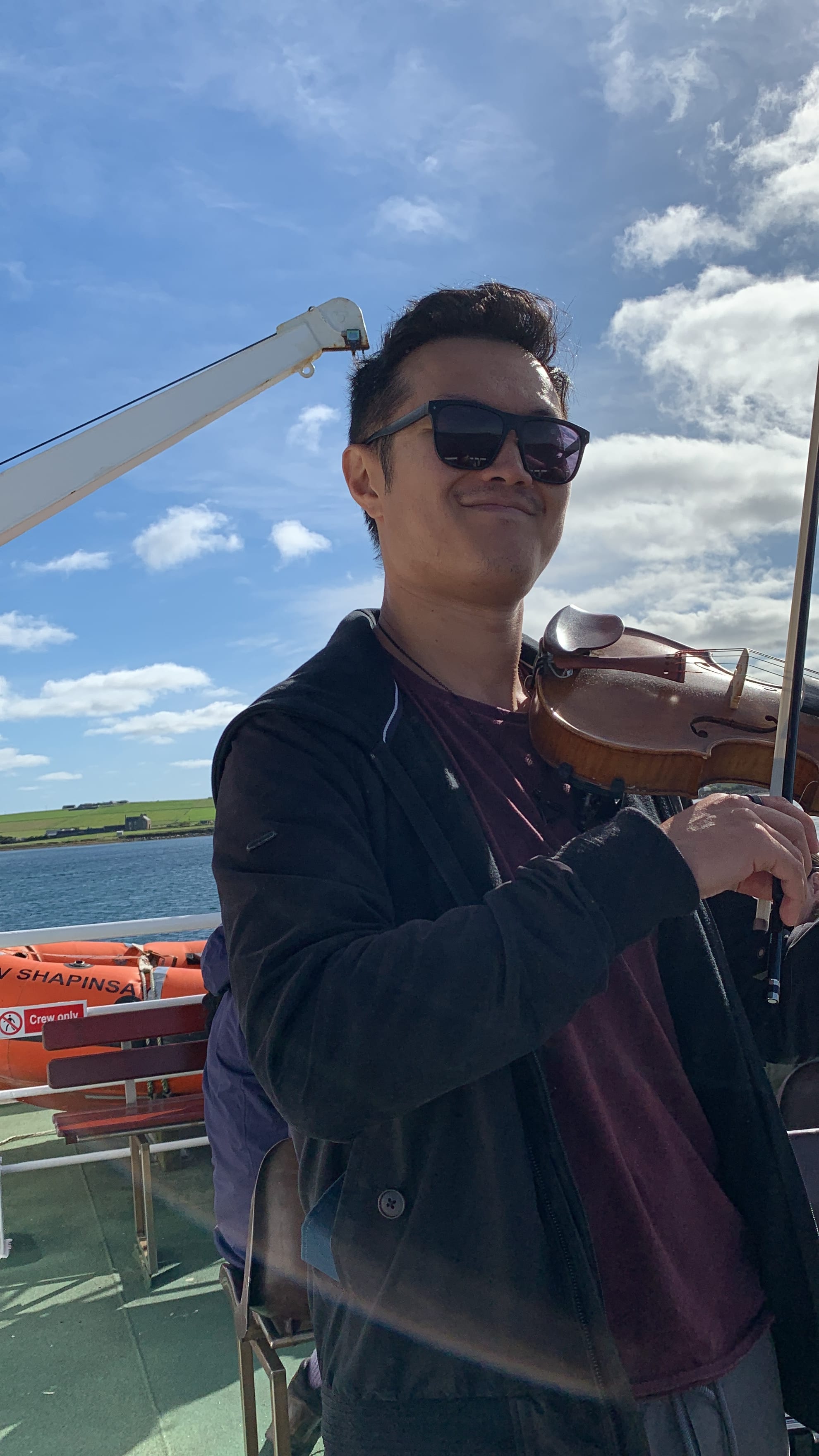
At one point, the group coproduced a game with Science Ceilidh, which somehow led to me working in a school on the Isle of Shapinsay amongst a group of deeply emotionally intelligent primary school children. I wondered how living on the edges in remote communities might teach us important lessons about community and responsibility.
Moments like this have stayed with me, not least for the brilliant impromptu ferry ceilidh, instigated by Lewis Hou.
I write about my work and my experiences because this is where my questions are growing from. Noticing areas of personal discomfort, horror, surprise, puzzles, tension, friction, places where awkward realities collide. This does not mean that my work was undertaken in isolation. Far from it. My work has always been filled with and supported by glorious collaborators from many different sectors. Colleagues, individuals with valuable life experiences, artists, teams from charities, health, education, care and the local authority, genuinely kind and open minded people who are individually incredibly skilled. I speak about my own experience but none of it would have been possible without generous connections from entire communities of people committed to improving lives for individuals and the wider community.
As part of my work, I became increasingly curious about the spaces where communication seems to bloom outside of language. A hand squeeze, recognition, mischief (a tickle of a feather), and connection emerging through gesture, companionable silence, storytelling, sensory experience, a shared glance, creativity, and simple shared presence.
Sometimes those moments felt more meaningful than verbal communication.
While working as an Activities Co-ordinator in a care home, hand and nail care was one of the things I was often asked to offer people. One man had a painful hand contracture and needed regular therapeutic hand massage.
After I gently massaged his hand, he unexpectedly took mine and carefully massaged it in return.
I remember the shock of suddenly becoming the recipient rather than the giver of care. It made me aware of how professional roles can hide mutual vulnerability. I had arrived imagining myself as the helper. The situation felt far less tidy than that.
Another time, during an arts session on a hospital ward, a man began softly painting onto my hand instead of the paper in front of him. Instinctively, I allowed it. I remember feeling surprised by the tenderness of the moment, and uncertain about where care, consent, humanity, creativity and professional boundaries began and ended.
Then he started singing in Gaelic. It was a song I knew, so I joined in. He laughed and sang louder. I don’t know whether he was laughing at my singing voice or at the novelty of a ‘sassenach‘ singing Gaelic with him. Possibly both. Either way, the moment felt deeply human.
I was asked about my painted hand back in the office and I felt unspoken questions about how it came about and why I allowed it. I couldn’t explain the depth of human connection I had experienced in that moment, how it felt much more than an outcome.
I think often, too, about my grandmother, whom I cared for at home towards the end of her life.
At the time, I experienced her as extraordinarily dignified in the way she accepted care. It was only much later that I started wondering what forms of adaptation, restraint, love or personality suppression may have existed beneath that acceptance. How much of that quiet dignity was born of love for me?
I will never know. And perhaps that uncertainty matters. I have started to think that recognising the limits of our understanding of one another may be an important ethical act of it’s own.
Even as somebody who has been a caregiver, I cannot possibly fully understand the experiences of all caregivers.
These questions followed me into other places too.
I remember older women in the Western Isles teaching me practical skills not through formal instruction, but through observation, rhythm, repetition and presence. Weaving, baking, knitting and singing, splitting herring by hand.
Most of the time nobody explained things. You watched, copied. Watched again. Eventually hands started understanding before your head caught up.
There was something deeply embodied about the learning. Knowledge seemed to move between people physically, between each other and culturally before it was ever fully verbalised. Perhaps unsurprisingly for a culture rooted in song and in a language which, historically, was often carried orally, learned at mother’s knee, rather than written down.
At An Lanntair Arts Centre in Stornoway, I co-ordinated projects including Arora and Cianalas, which explored dementia, language, culture, heritage, memory, touch and sensory experience through collaborative creative practice.
I worked alongside Dr Lucy Robertson here, during her PhD research exploring interactive textiles for wellbeing within dementia-friendly communities.
Together with communities across the Western Isles, this work included conductive-thread textile birds carrying recorded voices and stories, thermochromic textiles, sound-based mapping projects and sensory textile engagement.
What fascinated me repeatedly was not only the creative outputs themselves, but the way timing, readiness, emotion, memory and sensory recognition shaped people’s engagement.
Sometimes somebody was ready to connect with a piece of cloth, sound or memory. Sometimes they were not. The same object could mean entirely different things on different days. I will explain more about that in my essays.
Increasingly, I found myself less interested in certainty and more interested in the places where certainty begins to break apart.
The tensions or frictions between protection and autonomy. Between safeguarding and genuinely living. Between institutional responsibility and ordinary humanity. Between interpreting somebody’s needs and admitting that we may never fully know another person’s internal experience.
I think some ethical questions could be damaged by being answered too quickly.
People are often far more complicated than the systems surrounding them allow space for.
This matters to me because I worked as a care manager, where I was trained and expected to make best interests decisions, contribute to family court processes and navigate situations where the people at the centre could not always easily advocate for themselves.
How could I possibly understand the value somebody uniquely placed upon aspects of their life if I could not see beyond spoken language?
There is also something important for me about timing. I am writing this now with a level of distance and reflection that I simply did not have at the time.
When I was working in the Western Isles, in Hampshire, within arts organisations, local authorities, care settings and research environments, life moved quickly. Often relentlessly.
I do not say this ungratefully because that work was meaningful and important to me, and because I remain enormously grateful for all of my working and volunteering experiences.
But there were also annual reviews, funding pressures, contracts, line management structures, safeguarding concerns, budgets, targets and the ordinary practical realities of supporting my family and earning an income.
Often projects sat inside other projects and underneath all of that were real people within their families, communities and relationships.
At the time, much of my energy necessarily went into doing the work. Responding, facilitating, organising, advocating, managing and sometimes just trying to hold things together.
Only now, with more distance, have I started noticing how much remains unresolved beneath those experiences.
Certain moments stayed with me long after the paperwork disappeared.
Moments of discomfort. Humour. Horror, even. Silence. Reciprocity. Unexpected intimacy. Grief. Connection.
One session ended with the fire alarm going off. Another involved singing Gaelic on a hospital ward, by way of communication between people cared for in relative isolation, which ultimately led to a ceilidh in a shop where many community members heard about the event and turned up with instruments to play, even the spoons! Residents from one of the care homes sang traditional tunes amongst the racks of baked beans and porridge oats, accompanied by the clickety-clack of spoon music, led by a brilliant member of the museum team on his guitar. And there was a beautifully elegant ceilidh event in a stunning room with a spectacular view at Lews Castle.
These things sound almost surreal written down now, but they felt ordinary at the time.
Maybe that is part of what I mean by Notes from the Edges - reflections which could not fully emerge whilst being in the midst of constant motion.
Perhaps ‘edges‘ also refers to the edges of organisations, institutions, charities, groups and communities where my work so often seemed to sit.
I do not think my writing is an attempt to arrive at answers. If anything, I am trying to stay present with the questions.
To explore what it means to communicate, care, recognise, interpret and live alongside one another with uncertainty.
I keep returning to metaphors of blooming, flourishing, regeneration and dormancy, and I will explore these more throughout my seasonal essays.
With dementia particularly, language around decline often felt so dominant that other forms of humanity risked becoming obscured beneath it.
And yet I repeatedly experienced shared humour, tenderness, creativity, emotional connection and symbolic expression continuing to emerge long after conventional communication had become difficult.
I keep returning to blooming as a metaphor because it feels seasonal rather than clinical. Less about deficit. More about timing, vulnerability, change and continuation.
How do we carry ourselves, and one another, through change?
Perhaps this is what I am seeking to explore through these notes from the edges: not simply what is lost, but what continues to emerge, stubbornly and unexpectedly within all kinds of human relationships, often outside, outwith the limits of spoken language.