Spring Essay 2026
What Blooms at the Edges of Communication?
I arrived at our current home much resembling spring, suddenly blowing in like a snowstorm and before the landscape was ready.
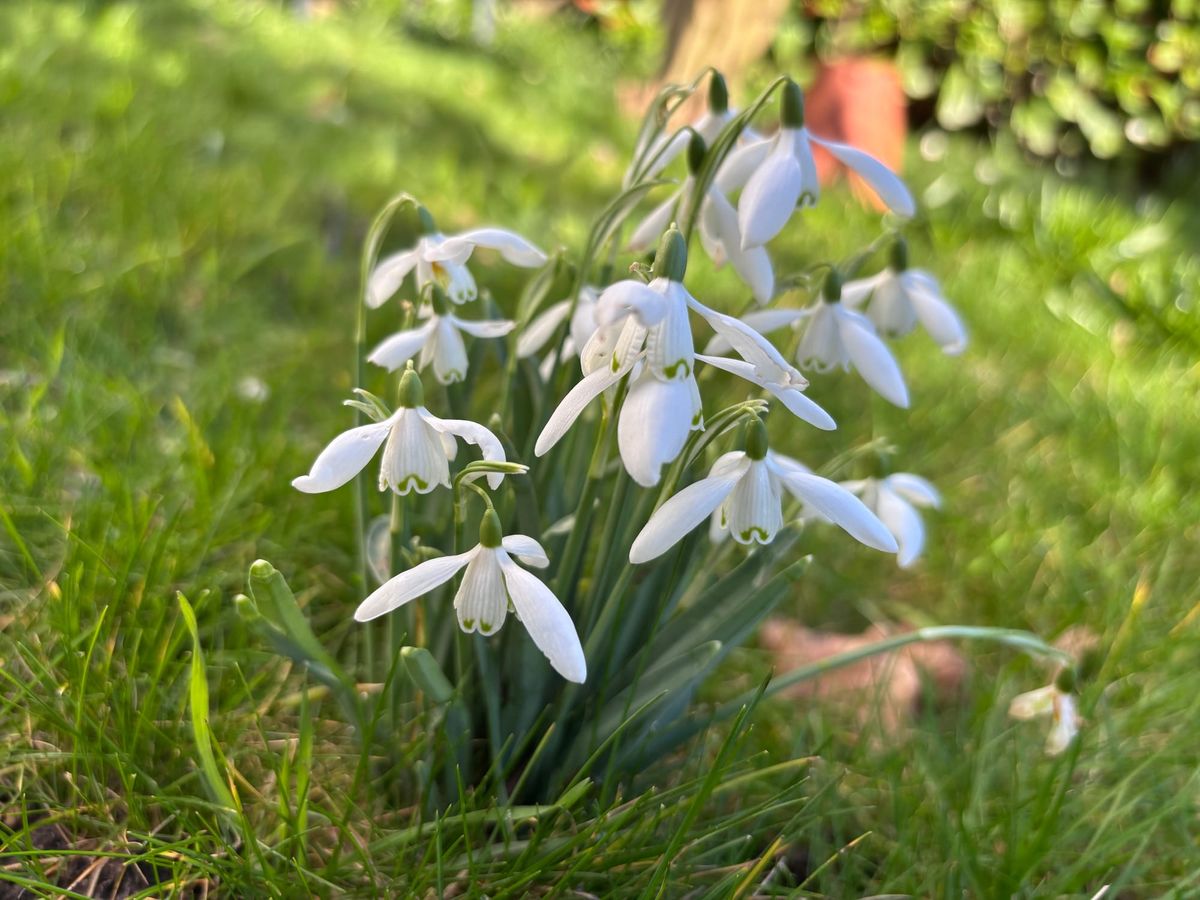
The snow had only just melted. Snowdrops still bloomed beneath lingering fallen leaves while Christmas roses fought for light and space amongst the debris left behind by the electricians after the house rewire.
Inside the house, the old lath and plaster kitchen ceiling had been taken down. Carpets had been ripped up. Abandoned freezers and worm-ridden chairs sat piled neatly outside awaiting collection by the bulky waste team.
Everywhere seemed caught between collapse and new growth. And then, almost immediately, everything began growing. Wild garlic pushed up through damp ground beneath trees just beginning to leaf. Walking around the garden, I found myself noticing something new each day. Suddenly bluebells, asparagus spears, primroses, relentless surprises popping up faster than I could register them.
There was an odd feeling of never quite being ready for the next thing and then the next. As though the landscape was perfectly happy to continue unfolding without me while I lagged behind, still seeking language to describe such abundance.
I noticed spring first through the careful planting of my gardener predecessors. I understood, before I could describe it, how deeply they must have loved this land.
The herb garden. Careful cultivation of (or perhaps simply allowing space for) wild edible plants for early spring harvesting. Ground elder, sweet cicely, dandelions, nettles. Siberian miners’ lettuce (thank you, plant identification app!). Not overtaking, even two years after the old gardener’s passing, but present nonetheless. Edible reminders that there are more ways to feast than simply nipping to the supermarket.
These people had clearly lived alongside the land rather than upon it. The feeling of being in tune with seasonal abundance was wordlessly present everywhere.
Landing on a connection, I think many forms of human communication and recognition emerge this way too.
Something changes before I fully process what is happening. A shift within uncertainty and I’m recognising something before I have an explanation or a name for it.
Across caregiving, dementia work, community arts and cultural projects in the Western Isles, I found myself returning to moments where something meaningful seemed to pass between people without speech. Not in moments where language became difficult or fragmented, but moments where recognition appeared to emerge through other means altogether.
Recognition in facial expression, touch, humour, timing, rhythm, silence, familiarity, mischief, sharing, sensory experience, or simply in human togetherness.
I noticed these moments in my heart and emotions before I had words for why they felt important to me. Later, more recently, I am beginning to understand how persistently they have stayed with me.
As Project Co-ordinator for the Cianalas project, one of my tasks was to support a tour of care homes across the Western Isles with the play Curious Shoes. The performance featured beautifully choreographed emotional scenes which felt clown-like to me. Very little required explanation. Instead, expression, timing, emotional exaggeration, humour and atmosphere seemed to move through the room in ways that felt immediately accessible. Some people spoke very little, some not at all and yet the room felt alive with recognition.
I remember watching expressions pass between faces almost collectively. A shared sadness, anticipation, mischief, sympathy, empathy. People looking towards one another with a kind of “Ohhhh…” over a lost love. Not explanation exactly, something more immediate than that. Something recognised emotionally before words fully arrived.
It reminded me of watching The Kid, starring Charlie Chaplin, during a screening at An Lanntair. Tears, smiles and shared glances moved silently around the room during the sadder moments. The exaggerated emotional language of silent film somehow seemed to bypass some barriers altogether.
I wondered if humans understand one another emotionally before we understand one another verbally.
A woman with partial vision once became completely absorbed while holding coloured lights during a session exploring sensory experiences at a care home.
I remember wondering what the lights reminded her of. Fairgrounds? Reflections on water? Dance halls? Christmas? Something from her childhood? Something private, anyway. She knew. I could only imagine.
I wondered whether the goal is always to interpret somebody’s experience. Maybe there is value in recognising that another person’s inner world continues to exist richly beyond our access to it, a depth of world we cannot fully reach?
I think often about silence too, especially within care. Is silence always absence? Might silence hold forms of care, protection, intentional restraint or emotional complexity that remain difficult to measure or understand?
I think about my grandmother, whom I cared for at home towards the end of her life. At the time, I experienced enormous gratitude for the tenderness and dignity with which she accepted care. Only later did I wonder what emotional adaptations may have remained unspoken beneath that acceptance. Whether love sometimes shapes what people choose not to say. Whether protecting others can become a silent form of communication.
These questions matter deeply to me not because I believe care decisions are simple, quite the opposite, because I believe they are often unimaginably difficult.
Families and carers might themselves be exhausted, frightened or overwhelmed. Maybe this is why humility matters. Willingness to recognise that another person’s internal experience may bloom beyond what we can confidently know about them.
I was and remain interested in communication which seemed to emerge outside of spoken language. A room collectively responding to humour. A glance exchanged between neighbours during a performance. People becoming visibly emotionally moved through music, atmosphere or rhythm. Hands reaching for familiar textures.
I remember sitting with a man on a locked dementia ward while discussing plans to repaint the ward garden woodwork. We slowly moved our fingers together across a wood stain colour chart. I playfully paused over a bright purple and we laughed. Bright blue received a firm shake of the head. When his finger settled decisively on a natural tree-trunk brown, I looked at him and said, “Ohhh. You would like the wood to look like wood?” He pointed at me enthusiastically and nodded.
This man had led a life of gardening and growing vegetables. For a ward ceilidh, I baked a chocolate loaf cake with carefully hidden carrot-shaped sponge baked inside. I iced the top with chocolate ganache and topped it with chocolate crumbs, to resemble soil, and pressed stalks of dill into the surface for leaves. When we cut into the cake together and the carrots appeared beneath the “soil,” he laughed and laughed.
I think perhaps I sometimes seek out ways of communicating beyond words too.
I remember bringing self-striping sock yarn to a woman in Harris who had previously taught me how to knit socks. She turned the yarn carefully through her hands while examining a finished pair I had knitted from it. “It makes its own pattern?” she laughed. “You just knit and the pattern appears?”And she laughed until tears streamed down her face.
I really enjoyed setting up these moments of connection to play out later.
I began to wonder whether some forms of communication become easier for care systems to measure and recognise than others.
I remember bringing a drumming workshop into a care home with Dal, a musician who brought a set of djembe drums with him. He explained what the drum signified and demonstrated how it was traditionally used. A few people in the room almost jumped out of their skins at the initial sound. Some laughed nervously. Some found it too loud. I noticed apprehensive glances passing between neighbours.
Then one brave woman slapped the drum “like a baby’s bottom,” sending a ripple of guffaws around the room. The atmosphere shifted almost instantly.
Dal began singing a Swahili song and demonstrated the call and response. Something about it seemed immediately familiar to the room. It reminded me a little of Gaelic psalm singing, that similar call and response. And we sang.
Then came the drumming. Each person slowly finding their own way into the rhythm with their hands. Dal used the symbolism of a heartbeat to explain the double beat. One hand on our hearts, one hand on the drum.
Bu-boom, bu-boom.
After half an hour or so, I noticed care home staff beginning to peer curiously through the little window in the door. At first I wondered what had drawn them there and then suddenly I realised how complicated the rhythm had become.
Some of the group had naturally separated into a bass rhythm beneath the main beat while others maintained the original pattern. The room was layered with timing, anticipation and coordination. Everybody must have been listening closely to one another, holding the rhythm collectively. How much embodied connection was happening in that moment?
And I felt shocked at how complex everybody’s playing had become. Then shocked at myself for expecting anything less.
How could I possibly know what capacities, creativity or complexity another person carries internally until they are given the right conditions through which to express it?
And yet some of the most profoundly human moments I have witnessed have existed within those spaces. I think about the language used around dementia, particularly. I have noticed so much emphasis being placed on decline, loss and diminishing communication that other forms of humanity seem to disappear from view.
And yet I repeatedly shared and experienced humour, tenderness, understanding, recognition and emotional reciprocity long after spoken communication had altered significantly.
I did not and do not experience these moments as absence. I experience them as something still blooming, not despite vulnerability or change. Blooming within human relationships. Another season of being.
One of the moments that has stayed with me most strongly happened at a care home where I had spent time over many months through arts sessions, music and trips out. A woman living there suddenly stood up from her chair as I entered the room. Her hands stretched wide slightly to her sides, her whole face lit up. There was clearly joy already present in her expression before the words themselves arrived.
“Oh! Oh! It’s………you!”
And perhaps that moment sits underneath many of the questions I continue returning to now. What is it that human beings continue recognising in one another beyond language? What remains emotionally noticeable when communication changes? What blooms between people before certainty, interpretation or explanation?
Perhaps this is part of why spring feels like the right place to begin with my essays, because spring might remind us that emergence exists before it becomes visible. Tiny shoots in readiness beneath cool soil, enthusiastic birdsong before leaves open, longer days arriving before warmer weather, ice thinning before it melts.
Life blooming anyway, regardless of whether we are yet ready to notice and give name to it.