Summer Essay 2026
What Flourishes in Our Hands?
My first summer back here in Aberdeenshire arrived like a much missed friend, bowling in arms thrown wide for hugs and yet more arms full of rhubarb.
One moment there were hopeful seedlings lined up in cold frames and the next, the garden seemed to be producing food faster than I could keep up with. Beans climbed, tomatoes sprawled, kale expanded, courgettes concealed themselves beneath enormous leaves like predators coiled in preparation for ambush. Every day I walked outside and found something else had exploded into life while I wasn’t looking.
Everything suddenly needed watering, staking, tying up, netting, untangling, harvesting or rescuing all at once.
The birds had their own agendas, carefully dissecting leaves from my borlotti beanstalks with seemingly surgical precision. Slugs munched their way through the odd lettuce, rabbits ate my round courgettes. Despite hungry fauna, the garden grew faster than my ability to contain it. Soft fruit weighed heavy on stalks and branches, much like the weight of expectation upon me to use and save it all without wastage.
Maybe because I arrived here after a long season of grief, responsibility and exhaustion, I experienced some of this abundance emotionally at first. Not only the food and flowers, but the feeling of life continuing to emerge so insistently. Stop all the clocks.
The lengthening northern light, visiting neighbours, the season for line-dried washing, seeds blooming into vegetables, the odd optimism of putting tiny specks into soil and trusting they might eventually feed somebody. Summer seemed to expand everything all at once. In daylight and flourishing abundance but also in conversations, ideas, memories and questions. I found myself noticing abundance in forms that had little to do with productivity or perfection.
Knowledge proliferated too, as I revisited recipes carried through hands rather than books and neighbours dropped by to share growing advice and knowledge about this land.
I’ve always enjoyed folk and cultural songs about the work of the seasons and some of these songs of labour stayed with me. I found myself singing them. I found myself hearing the melodeon tunes in my head of the Uist Quadrilles with the work Kate Macdonald did through the Cianalas project and the film Andy Mackinnon made. There is so much embodied mathematical, physical and relational knowing in this film that it’s hard to put into words. But the music stays with me.
This makes me think of the recent work of Clare Boreham Kerr for Tate Schools, exploring the work of artist Nnena Kalu through movement, mark-making and embodied creative practice. This takes me right back to An Lanntair and creating community sessions with artists. This resource could be so helpful for embodied arts work with people of all ages. There’s a link to discover the resource below and I’d highly recommend it as a way of seeing, which is a recurring theme in my own explorations. The more I look, the more I see understanding and self expression emerging through embodiment, movement, making, participation and relationship, as well as through words.
Clare’s work also links me back to the work of Science Ceilidh, embodying science through dance and to the dance in Andy Mackinnon’s film, linked below, with Uist Dance and Cianalas, embodying maths through dance with the children and the whole community. And the embodied game ‘Dementia Through Our Eyes’ that the Scottish Dementia Alumni created with Science Ceilidh.
I think of the two year old boy at the nursery where I worked, who was completely absorbed with pushing stones into an old piece of hosepipe. I joined him and we wordlessly discovered a mathematical and physical world of estimation, bigger, smaller, counting and measuring, movement, weight and force through those few, short minutes. How many would fit, do we think this stone is too big? Will this one fall out of the bottom or get stuck? Will blowing into the tube release the stone?
Do we need expensive resources for quality learning moments? Or can we seize quality of opportunity with what’s around us?
Back in Aberdeenshire, neighbours stopped by with advice about soft fruit, stories about what had grown well here before or spare jars passed into my hands, and I caught myself thinking about the kind of knowledge that travels informally through communities. The kind of knowledge that doesn’t need instruction manuals or institutional recognition but exists through repetition, participation, memory and ordinary conversation.
Long before I had language for concepts such as embodied knowledge or tacit learning, I was noticing moments that stayed with me. A woman in Leverburgh showing me how to measure a sock, not with rulers or measuring tape, but against her fingers and hands. A housewife who showed me how to split and fillet herring with my bare hands. A retired schoolteacher from Balallan teaching me how to make duff entirely through texture, sight and feel. There was no written recipe. Afterwards, I remember carefully weighing and translating her instinctive handfuls into formal measurements so that I could document them. Even then, I suspected the written recipe was somehow the lesser version of the knowledge.
At the time, I experienced moments like this as interesting, emotional or memorable but with some distance, I found myself wondering about the kinds of understanding that bloom through relationships, shared activity and ordinary conversation.
Scottish Gaelic is often spoken about as a language learned ‘at mother’s knee‘ through immersion, listening and repetition rather than through written language alone, or even at all. I found myself noticing that understanding seemed to exist richly within communities long before it was written, organised into categories or institutionally recognised.
During a session with Dr Lucy Robertson’s Creative Clans work, one woman laughingly reflected ‘You men carried peats. Us women carried peats while knitting a sock and singing to the children.’
Before the room could settle too comfortably behind the women, one man immediately replied, ‘If you had enough breath to sing while carrying peats, you weren’t working hard enough!’
The room erupted into laughter.
Women repeatedly joked that whatever they were doing had been done ‘while knitting a sock.’ Carrying peats while knitting a sock. Looking after children or watching the soup bubbling while knitting a sock.
The phrase stayed with me partly because it was funny, imagining a limp sock dangling in front of any activity, but also because it seemed to hold something bigger about the layering of women’s labour, focus and endurance.
At one point, I tried carrying peats myself, partly because I wanted to understand how a woman could possibly carry peats while knitting and singing simultaneously. Very quickly, I realised that I could not. Even the sock defeated me. I somehow managed to twist the cuff into a kind of perpetual doom spiral of despair before I had properly begun. My efforts of carrying produced barely enough peats for a single day and my stacking skills were pitiful.
Even while attempting the work, I became humbly aware that I was approaching it entirely from outside the conditions which had shaped the women I was thinking about. The further I tried to move towards understanding their lives, the more aware I became of how much I could never fully understand.
One man in Shawbost told me that even now, while cutting his own peats, he could still hear the talking and laughter of the old crofters working alongside him. The comment stayed with me because it seemed to express something much bigger than memory, as though certain cultural practices allow past and present to sit unusually close together.
Peat beds aren’t only landscapes, are they? They carry seasons, labour, mischief, weather, companionship, community and continuity layered across generations. Perhaps continuity does not live within memory, but within participation. Within the doing. Within bodies continuing actions practised by others before them and those before them. ‘Tea tastes better on the machair.’
Lewis Hou brought elements of Science Ceilidh to Lewis while I was working at An Lanntair and one of the sessions which really made me think about embodied knowing was at a day centre, where we danced with a group of people who had learning disabilities. I knew that learning about patterns, speed, counting, embodied maths and physics, was happening there, in our bodies. And although Lewis understood the complexities on paper, none of the rest of us did. We knew it in other ways entirely.
I experienced Hebridean life as forward thinking, rather than nostalgic. Science, research, arts, innovation, creativity, education was all central to my orbit, as was frequent travel and preparedness.
Much like a visit to the nostalgic Dorset fishing village of Tyneham, where romance terminates in the graveyard, full of children who lost their lives to now-curable or preventable illness and the man who died of infection from a fishing hook in his finger, one lady said to me of the romance of Hebridean past life..
‘and then they built the road…the road out.’
And when I asked my great aunt to tell me about ’the olden days’, she reminded me gently that to her, they were just days.
Reading older accounts of the Hebrides, I am often struck by how frequently visitors expressed surprise at encountering technical skill, design knowledge, humour, adaptability and entrepreneurial thinking within communities they described as remote or culturally peripheral.
One of the projects we explored through Cianalas at An Lanntair was Barvas Ware pottery. Partnering with Museum Nan Eilean, Euan brought some examples of the pottery and some archive extracts from writing of the era to several community groups across the islands and as we handled the pieces, he read extracts about what travellers had expected to find and what they did find, in reality.
I’ve read about researchers describing the women potters of Barvas in terms of their skill and enterprise during a time of economic and social hardship. Working with local clay, peat firing and milk glazing techniques, they produced pottery that appears to have drawn inspiration from commercially produced tea sets and ceramics arriving from centres such as Staffordshire and the Scottish Lowlands.
What interests me is not so much whether the pots successfully reproduced fashionable china, and more that the women making them were likely observing wider trends, adapting ideas and responding creatively to new opportunities while drawing on existing local knowledge and materials.
The closer I look, while I find ‘isolated‘ communities preserving traditions, I also find people observing, adapting, experimenting and making. I didn’t experience remoteness or isolation, living on the islands. I began to wonder what ‘remote’ and ‘isolated’ meant and who decides. I’ve certainly felt more isolated in cities and living on the islands felt central to me at that point.
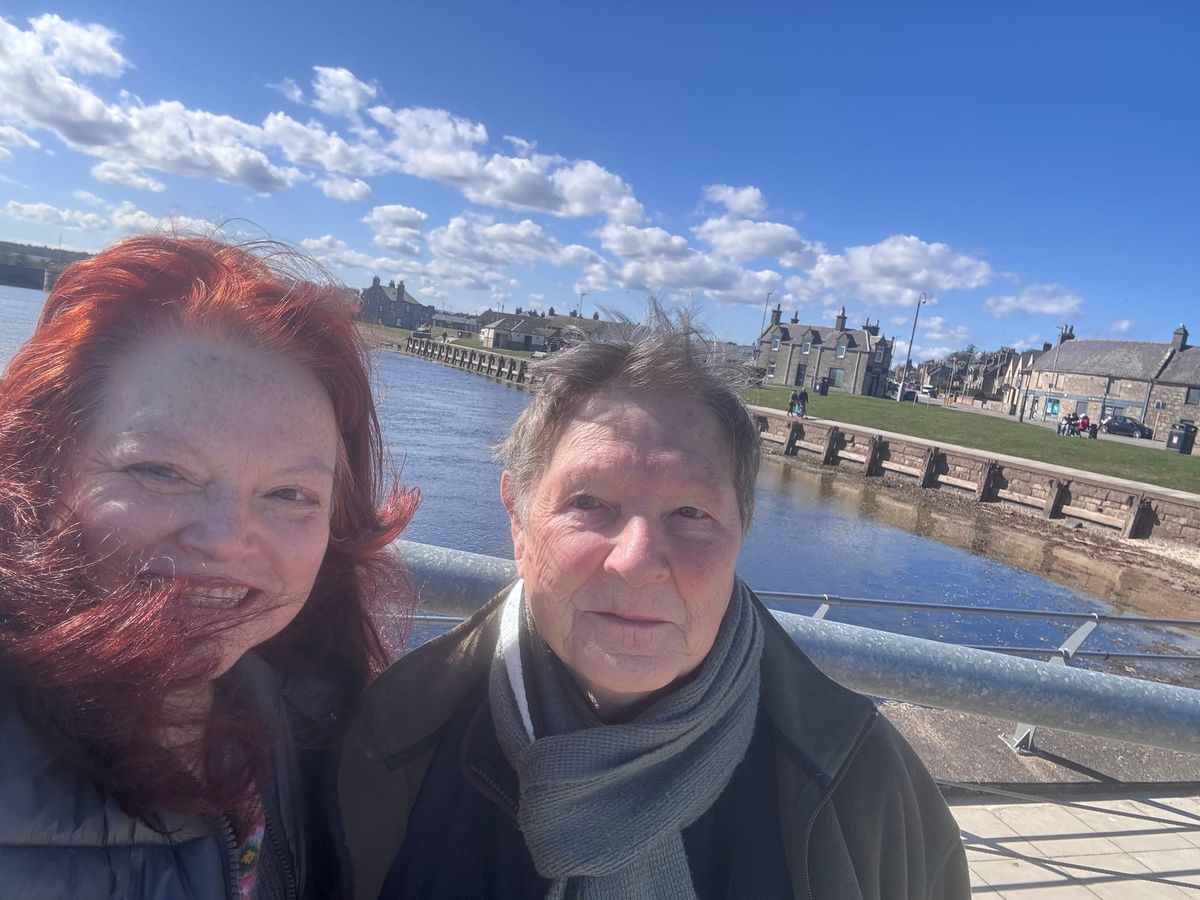
I first met James McKillop through my work at An Lanntair. Over the following years we collaborated on several dementia related projects, and over time became firm friends. We met up in Lossiemouth a few weeks ago.
Recently, I asked him some questions about photography after finding myself thinking about my own changing relationship with images. I have noticed myself longing for slower and more tactile forms of photography. I miss anticipation. I miss holding photographs in my hands. I find myself returning to Polaroid cameras, cyanotype printing and printing some of my digital photographs rather than leaving them unseen in my phone.
I found myself agreeing completely with James about the anticipation of waiting for photographs to return through the post. He described the “breathless anticipation” of waiting for slides to come back from Kodak, “building up to a climax, waiting for the postman.”
Digital photography brought freedoms with it. James described it as “heartening” to be able to “see your efforts immediately,” to “delete any rubbish ones,” and “to try again and again for a better shot.”
And yet, despite welcoming those changes, he still told me of feeling that film offered something digital photography has never entirely replaced. Reflecting on old slides, he wrote: “You could put a slide in a projector, be able to spot further details, and show them to others in the room at the one time, unlike phones being passed from hand to hand nowadays.”
I was also struck by the way James described the physical changes photography has undergone within his own life. He told me that he once “used to walk for miles for hours” to reach waterfalls and other photographic locations. On holiday in the Isle of Cumbrae, he walked from Millport round to the west coast and sat for hours, sometimes in light rain, to get a photo' of a sun ray beaming through the clouds. Usually he retreated home disappointed. But one time he did manage to catch one.
Today, he “can now only walk short distances” and has “had to find other easier subjects.” His current camera, a Nikon D7200 is sturdily built, and he finds he can only take photo's for a short time, as arthritis in his hands, becomes too painful. At Lossiemouth, he found himself seeking “sunsets, clouds and vegetation.”
There was something touching in the matter of factness of this. In the adaptation of artistic attention.
Later, reflecting on his photography book Opening Shutters Opening Minds, he explained that part of its purpose was to challenge widely held assumptions that people living with dementia were incapable of originality or creativity.
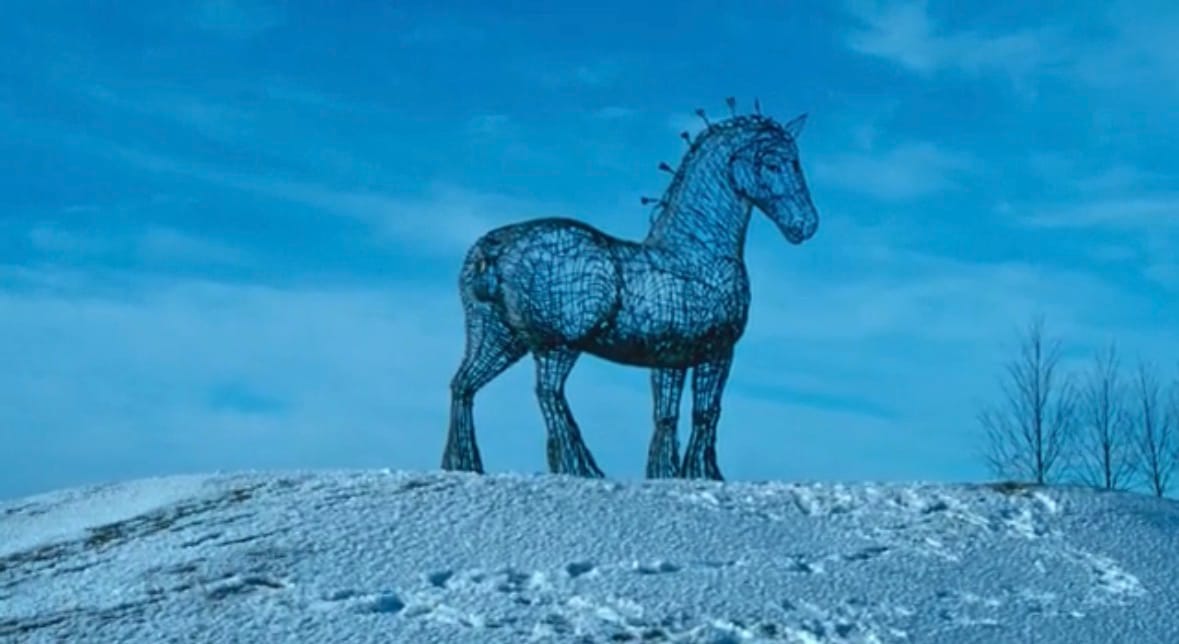
I asked James about his image of the horse sculpture in snow. He’d told me about this years ago, how after terrible experiences with one assistant, he met Brenda, who cared enough to listen to James’s wish to capture these images, to wait for snow and to make it happen.
“I feel that my emotions are hard to express since dementia entered my life. But I did feel satisfied in some way, I had achieved something I long wished to do, as the general public and most upsettingly professionals, thought we were incapable of doing anything worthwhile.
I loved the result, and it is in my book. It was meant to open the public’s eyes, that we still existed, and could do what the average person took for granted.”
Do photographs need words in order to communicate something human? I wonder if the act of noticing carefully, waiting for light or snow, framing an image, or choosing what feels worth preserving is already saying something. Art is supposed to enable us to feel something, isn’t it? In the creation as well as in the connection?
I’ve absolutely experienced a tender kind of love and respect for mountains in Alex Boyd’s images, having met Alex and encountered his work at An Lanntair. Somehow, the images feel simultaneously crisp and soft to me. The process itself feels embodied. The photographs feel lived with rather than taken.
I’m reminded of a lovely film The Scottish Island That Won The Lottery, featuring Kate, who worked with me on the Cianalas project. The film raises, for me, tender questions about whether flourishing is about accumulation at all and what we really need to make us happy.
Maybe it is about depth of relationship to a place and one another and our shared histories. About the slow gathering of embodied knowledge over our lifetimes.
I think sometimes of the retired fishing captain who had not spoken for some time, and the shock I experienced at hearing his voice as he taught me how to mend the fishing nets in his hands.
‘You hold it like that, a little further back, yes, now over and over’, as he demonstrated.
The experience of seeing his past colleague and friend, of handling the nets, of hearing the cultural stories, seemed to free up his spoken language. I wanted to counterbalance my insistence about unspoken communication being important with this story, where words were incredibly important in this session. David Robinson wrote about it for The Times.
One of my first social care and arts projects was based in Poole, Dorset, where I worked at a care home with an artist, collecting fragments of words to assemble into poetry, to go with graphite drawings made by the Swedish artist Karin Sköld. I sat immersed in grand stories of button makers, George Formby, long and well lived lives and handbags clutched to knees, no longer containing door keys or family allowance books. We exhibited the work in the library and one man said ‘I was so touched to hear the human stories and the images were so tender. It really made me think about my own father and that I need to listen to him more.’
I think it’s most likely that our human systems are built with the very best intentions rather than being malicious but I think people might consistently exceed the categories created around them. Maybe flourishing happens in far more places than we have taught ourselves, as societies, to notice.
It might be that abundance exists not just in gardens and harvests, but in the extraordinary accumulation of embodied knowledge, humour, care, adaptation and relationship carried through our ordinary human lives.
And maybe some of the richest forms of human understanding remain slightly outwith the things modern life most easily inhabits, measures, markets or rewards.
References
Wilson, K. (2008). Women Potters of Barvas, Isle of Lewis, Outer Hebrides. Interpreting Ceramics, Issue 10.
Pickles, H. Barvas Ware and Craggans. High Life Highland / Highland Folk Museum.
Robinson, D. (2016). How to catch memories with a torn fishing net. The Times (Scotland).
The Scottish Island That Won The Lottery – Firecrest Films where to watch
Completing the peat project cycle with a walk (2018) – Cianalas blog post reflecting on carrying peats while knitting a sock.
Soundcloud Sock Knitting Lesson in Leverburgh - P Brown
Boyd, A. (n.d.) Biography. Alex Boyd. Available at: Alex Boyd Biography (Accessed: 10 June 2026).
Mackinnon, A. (film-maker). Uist Quadrille Project (film produced for Uist Dances, Ceòlas, Cianalas and Dementia Friendly Community activities). Available at: vimeo (Accessed: 10 June 2026).
Boreham Kerr, C. (2026). Teacher Spotlight: Nnena Kalu. Tate Schools Resource (Accessed: 10 June 2026).
Dr James McKillop MBE (2021) Photography and Self Management, YouTube, (Accessed 14th June 2026).