Halloween: A Little Something for the Living and the Dead

There is something rather lovely, I think, about the idea that, at this time of year, the distance between the living and the dead might become a little smaller.
Do I believe in ghosts? Not really but I do think that there’s a great deal as yet undiscovered about living, dying and the possibilities in between. I’ve definitely experienced unexplained phenomena but it doesn’t frighten me at all, rather it inspires deeper curiosity.
Halloween has accumulated quite the collection of customs over the centuries. Some have survived almost unchanged, while others have been adapted, forgotten or maybe rediscovered. Under the costumes and lanterns are older traditions concerned with the turning of the seasons, the gathering of the harvest and our relationship with those who came before us.
Here in Aberdeenshire, where we are spending our first autumn at home in this house, I have been exploring some of those traditions through the food that people once prepared and shared.
Halloween in Scotland
Scottish Halloween has a rich history of games, divination and gatherings around the hearth. Young people once pulled kail stalks from the ground to discover something about their future sweethearts. The size and shape of the stalk, and even the earth clinging to its roots, could supposedly reveal something about the person they would marry.
Apples and nuts (and sometimes peas) were used in games that promised glimpses of the future. There were gatherings, stories and most likely a good deal of laughter.
Robert Burns recorded many of these customs in his poem Halloween, published in 1785. His descriptions of rural celebrations offer a wonderful glimpse of a world in which ordinary materials of household and agricultural life became part of the evening’s fun.
There is something quite amusing about the thought of people gathering after the work of the harvest, making fun from whatever happened to be available.
In Aberdeenshire, as elsewhere in Scotland, local customs developed their own character. Folklore was carried through families and communities, changing a little with each generation. Food belonged to this world of shared experience too.
Soul cakes and the remembrance of the dead
The tradition of making soul cakes is particularly associated with parts of England, where small cakes were given to people who went from house to house around All Souls’ Day, sometimes offering prayers for the dead in return. The custom was known as souling.
The cakes varied according to place and household. Recipes commonly associated with the tradition contain oats, flour, butter, sugar and spices, sometimes with dried fruit. There is something warm about the exchange. A little food offered in remembrance, carrying an acknowledgement of those who had died.
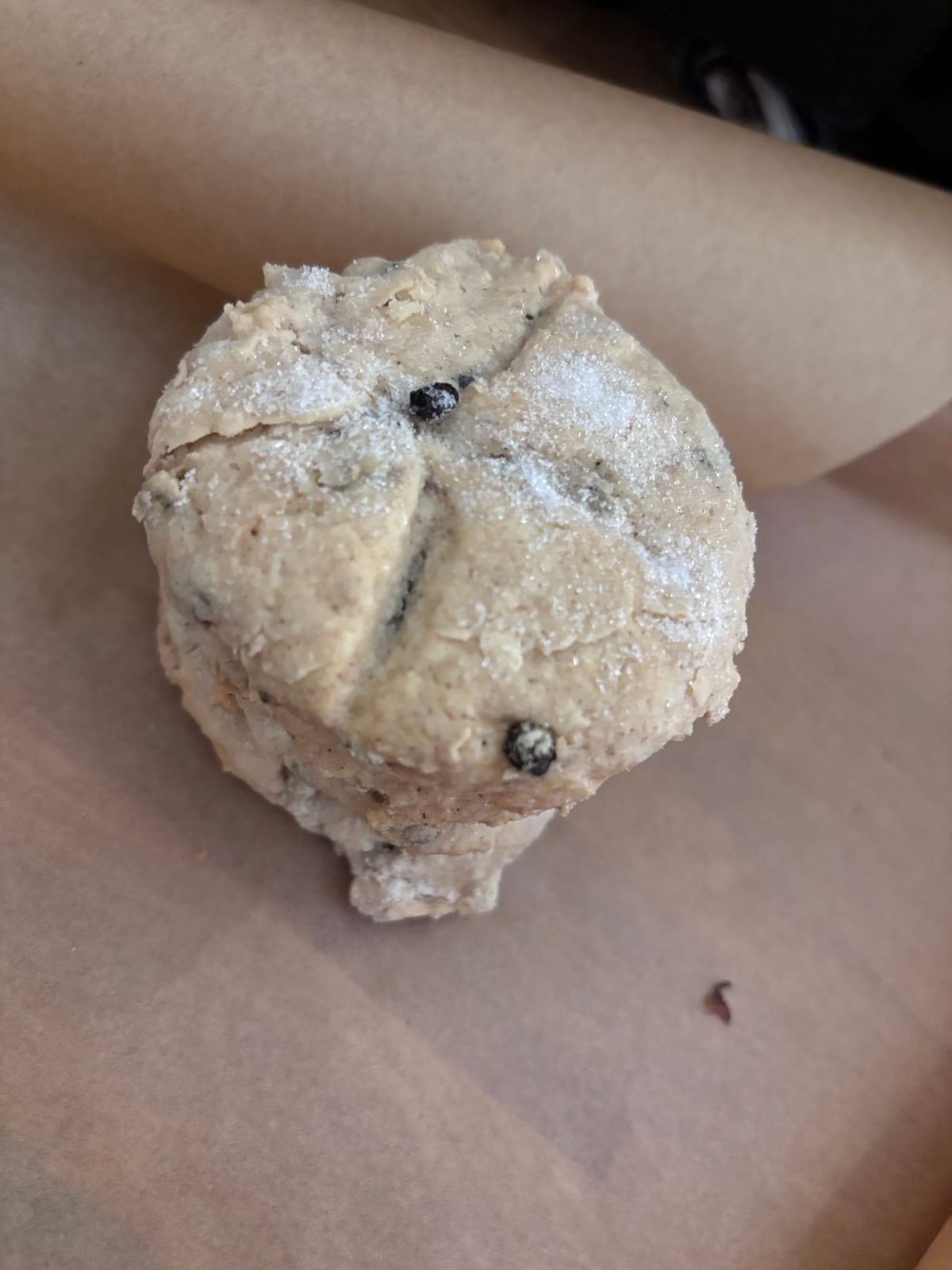
It also reminds us how closely food, belief and community life were once connected. I decided to make some soul cakes of my own. This seemed an entirely reasonable undertaking. I bake regularly, make bread and pastry, and have become quite accustomed to working with dough.
Unfortunately, the souls of the departed may have had other ideas.
I began in the food processor, intending to finish the dough by hand. Somewhere along the way I suspect I added too much milk. The mixture became hopelessly soft and claggy, attaching itself enthusiastically to my fingers.
I washed my hands, tried again. I washed my hands again.
By the third handwashing, I was beginning to lose patience with the entire endeavour. The dough clung to the biscuit cutter, resisted being lifted from the worktop and eventually produced a collection of rather misshapen cakes with craggy tops. I put them in the oven anyway.
Fortunately, I had enough sense to save half the dough in a bag in the fridge. Perhaps an overnight rest will allow the flour to absorb more of the liquid. I can always add a little more flour tomorrow.
As I contemplated the wreckage of my baking session, I began to imagine the souls of the bakers who had worked in this old kitchen before me. Maybe they had been watching the whole performance, heaving with laughter.
Imagine waiting decades, perhaps a century, for some decent entertainment, only for a woman to arrive with a food processor and make such a spectacular muddle of a simple cake.
Tomorrow, they might gather again to watch the second attempt. It might be the first good laugh they’ve had in a hundred years.
Bannocks and the Scottish kitchen
Although soul cakes belong particularly to English traditions, Scotland has its own long history of baking simple cakes and bannocks.
Bannocks were made from the grains available to a household, particularly oats and barley, and cooked on a girdle or griddle. Their ingredients and preparation varied considerably between regions and according to the means of the household. They were part of everyday life, but food could also acquire particular significance at seasonal gatherings and celebrations.
I‘m interested in these simple preparations because they tell us something about the materials people had available and the knowledge required to make use of them. A household with oats, a little fat and access to a fire could produce something sustaining. The skill lay in knowing how to prepare it, judge the mixture and manage the heat.
Much of that knowledge was learned through watching and doing. Maybe my soul cakes would have benefited from a little more of that.
Buttered sowans for Halloween
One of the most intriguing references I found while exploring Scottish Halloween food was in Robert Burns’s notes to Halloween. He describes sowans served with butter as the customary Halloween supper.
Sowans are an old Scottish preparation associated with oats. Traditionally, the husks and bran left from processing oats were soaked in water and allowed to ferment. The liquid was strained, and the starch that settled from it could be cooked into a sour porridge or pudding.
The preparation reflects an economy in which every useful part of the grain mattered. It also offers a reminder that fermentation belonged to ordinary domestic food preparation long before it became a subject of renewed culinary enthusiasm.
I was particularly interested to find references to sowans in the northeast of Scotland, including evidence of the equipment once used to prepare them. An old sowans sieve associated with Strichen in Buchan provides a material connection to a food that has largely disappeared from everyday kitchens. Also, apparently, a position on gossip, through the imagery of a sieve letting matter fall through.
I have been thinking about making sowans myself, especially as I have access to locally grown oats. It will need some further research and a reliable method for safely managing the fermentation but the prospect of making something that might once have been familiar in kitchens around here is rather appealing.
There is something quite exciting about the possibility of recovering a taste from the past through a handful of grain and a little practical knowledge.
A small gift for the neighbours
I have been thinking about making some little parcels of soul cakes for our neighbours. Wrapped in paper and tied with string, they could carry a short account of the tradition.
Perhaps a little about souling, or the old Scottish Halloween games, or Burns’s account of buttered sowans. I like the idea of giving someone a cake with a story attached.
My poor neighbours have dutifully tasted gooseberries, rhubarb, medlars, ground elder, elderberries and flowers, sweet cicely, rose hips, hawthorn ketchup, stuffed pumpkins. They might be quite glad of a plain dried fruit cake tied up with a story.
Food has always been one of the ways people express hospitality, and the stories that accompany it can be as interesting as the recipes themselves.
Someone might remember a Halloween custom from their childhood, or something their grandparents used to do. A little parcel of cakes could become the beginning of a conversation.
I wonder how many old customs survive in fragments of family memory, waiting for someone to ask about them. And maybe that is one of the pleasures of returning to these traditions, to offer opportunities to learn about the people who lived in a place before us, and to share something with the people who live around us now.
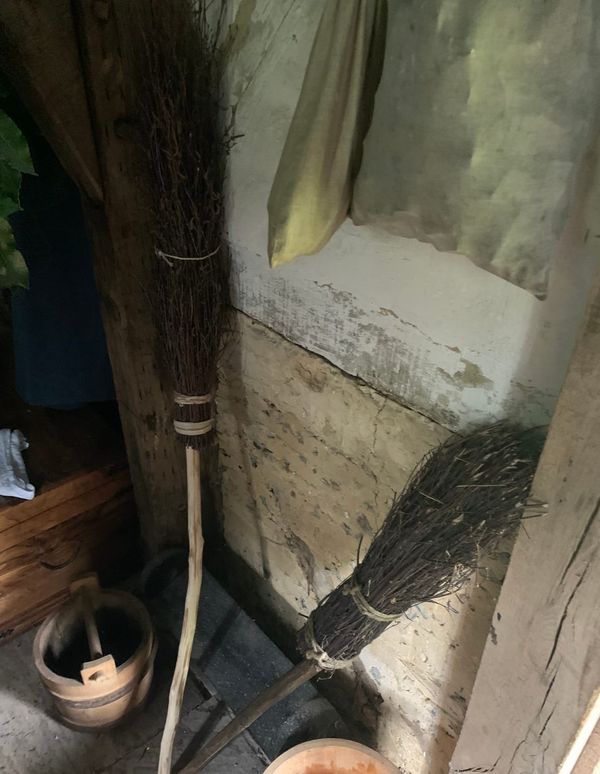
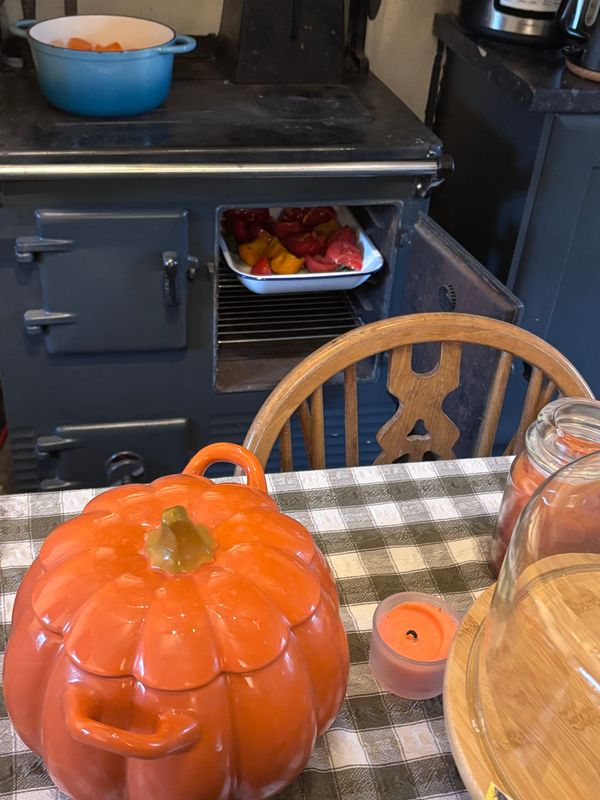
I have bought/inherited an old house with a kitchen that has seen many generations of cooking. I often wonder about the people who stood where I stand, what they prepared, and the conversations that took place while they worked. This Halloween, I shall be thinking of them.
And if tomorrow’s soul cakes are as troublesome as today’s, I hope they enjoy another good laugh. There may even be a cake left out for them.
Update - my neighbours loved the soul cake tradition and brought lovely cake and gifts and a card in return.
If you fancy making soul cakes, here’s a basic modernised recipe. Take care to only add enough milk to bind your cakes and not so much to have you questioning your life choices.
Soul Cakes
Ingredients: caster sugar for sprinkling.
175g butter, 175g caster sugar, 3 egg yolks, 450g plain flour, 100g currants plus a few extra for the tops, an extra tablespoon of caster sugar for sprinkling on top before baking. Keep the butter paper to grease your baking tin. 2 tsp mixed spice and a little milk to bind the mixture.
Method:
Preheat your oven to 180 c and grease your baking tray. Cream your butter and sugar together well and then mix in the rest of your ingredients, binding with your milk. Lightly flour your work area and roll out the dough. cut out rounds and place them on your baking tray. Cut a cross in each one and place a currant at the centre. Sprinkle with sugar. Bake until ligthly golden. It should take about 10-15 minutes unless you added too much milk, like I did. Mine took about 25 minutes. It also depends on how deep they are. I think they are perfect when the base starts to turn a little golden, when lifted carefully to check.
Good luck!
Research and references to explore
- Soul cake song River of Song accessed 31/10/26
- Soul Cake by Sting on Apple Music accessed 31/10/26
- Robert Burns, Halloween (1785), Scottish Poetry Library, accessed 31/10/26.
- Alexander Fenton, Buchan Words and Ways, for the wider food culture of northeast Scotland. Scottish Corpus accessed 31/10/26
- Historical evidence of sowans preparation in Buchan, including the sowans sieve associated with Strichen, dated around 1840.
- British Food History making sowans accessed 31/19/26
- English Heritage accessed 31/10/26
- Historic Environment Scotland, Samhainn and the Scottish Traditions of Halloween. An introduction to Scottish Halloween customs, including guising and fuarag. Accessed 31/10/26.
● Banffshire Field Club (1932), Folk Beliefs in the North-East of Scotland. Accessed 31/10/36
- National Trust Halloween in Uist accessed 31/10/26
- Halloween tradition recordings Tobar an Dualchais accessed 31/10/26