Pompey Girl

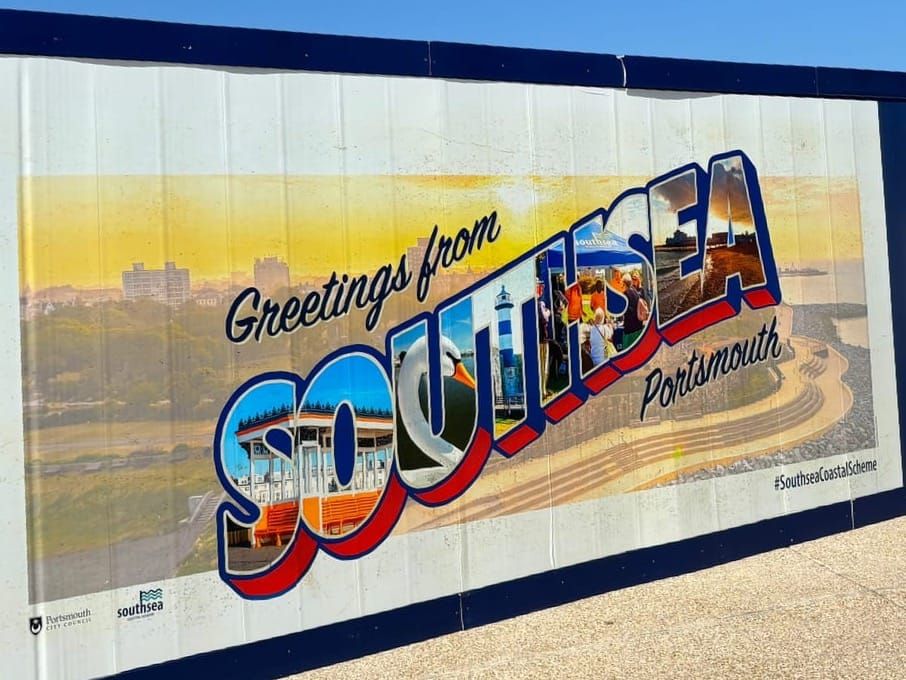
With the prospect of moving back to the Portsmouth area soon, I’ve been thinking a lot about where I’m from, as opposed to where I am.
I do feel that I belong here in Aberdeenshire, although it’s more because the people are lovely than because the place is recognisable to me. Portsmouth is familiar in a different way. Its streets, buildings, seafront and local sounds are part of me, even though I don’t always feel part of the life of the city. And because I’m so old now, much of the city I knew is gone. And many of the people.
I was born in St Mary’s Hospital and spent my earliest years in the North End area. It was lovely being close to my grandparents’ house, and to the places where my dad and grandad worked. Then we moved “up the hill”, where I started school in Purbrook, before coming back to Cosham for middle and high school. Those names and routes still sit in my sense of Portsmouth.
Going back, I hear familiar slang words that I never really used myself. They’re part of the background chatter, and they feel warmly familiar, even when most of them are a bit negative. You don’t have to speak a place’s language for its sounds to become part of your memory.
“You dinlo!”
“Getting lairy” means getting mouthy. “Stop squinnyin’” means stop whining, and it rarely has the g on the end. Someone might say, “Keep your wool on!” or “Keep your hair on!” or even “Keep your beard on!” A surprised or impressed person might exclaim, “Wheeee!” Teachers had their favourite “Settle down!” and others outside of school might say “Ease up, love!”
Then there’s “’E only went and chored my bike!” Chored means stole. I sometimes heard it pronounced chorled so I’m not sure of the spelling. Or if it has ever been written down. “I got new clobber” means new clothes. “Don’t start!” is a warning shot. “Are you startin’?” can be an invitation to a brawl. ‘Do you want some?’ No thank you, kind sir. Whatever you’re offering. Not today, thank you! That’s another one.
“She’s copped” means she’s lost her temper. Sometimes it’s “copped the needle”, though I’ve no idea where the needle comes from. And every child knew the warning: “You’ll cop it!” You will soon see the consequences of your actions, young person. Chuffed means proud or happy, with well chuffed saved for those special occasions.
Then there’s mush (pronounced rhyming with whoosh), a bloke, a mate, possibly someone whose name you’ve forgotten. “Alright, mush?” And “right in the mush” means right in the face.
I once overheard a mother in a supermarket say, “’armony, stop ’ittin’ your bruvva!” Harmony, huh? The name made the whole reprimand even better.
And “Oi!” A common way to call to somebody across the street, or a finger whistle. I don’t think I’ve heard as many finger whistles anywhere else.
One school friend often called me a ‘pranny’. I don’t think it was personal to me. I think she called everyone a pranny at some point. I still have no idea of the origins. Possibly from the word prat. She used that a lot too. I’m not sure if it’s particular to Portsmouth but I don’t think I’ve heard it anywhere else. Maybe I was more of a pranny in my younger days?
The city has its own little map in the way people talk. Commercial Road was “down town”, usually pronounced “dahn tahn”. You went “up the ill” to Portsdown Hill, and “dahn the beach” or to “the front” at Southsea. People joke about the Guildhall steps as a way of making money. I have no idea what they mean. Playing the spoons?
‘I’m after a bag of cement’, you might hear at a builders’ merchant. I often hear this when somebody has been chasing after something for a while with no luck.
There’s still talk of mudlarking, which was usually children searching for coins at the muddy shoreline and people often dug for whelks or winkles there, to sell. Sadly, some have met their end doing just this. There are some awful stories.
Portsmouth has two piers, Clarence Pier at the fairground end and South Parade Pier, with a penny arcade, and which used to have a roller disco at the end, in the ‘80s, which I loved. I also used to catch mackerel there in the summer as a teenager. This one is near Canoe Lake. I’ve never seen a canoe on it but there are a few pedaloes and there’s a long history of model boats there. The Natural History Museum is brilliant and a long lasting childhood memory. I hope it’s still there. The papier maché T-Rex is incredible, if getting a bit battered. If you follow social media, the Southsea Model Village account is really worth a follow.
Some of the Portsmouth words sound a bit East End of London to me. London is only sixty-odd miles away. Cushty is something you’d hear Del Boy say. I suppose it might be a predecessor of cool. Daft aporth (a what? Investigation gifted the knowledge that its shortened from half penny worth - small thing. Silly child. Daft ‘ap’orth’). While working in Andover, I noticed a few familiar words, maybe spreading into neighbouring towns or common to Hampshire.
I won’t tell you what a ‘dockyard oyster’ is. Some images you can’t unsee.
Some local businesses have started putting the more iconic phrases on mugs. I love that. Even though I don’t really say these things, they’re part of the tapestry of my life.
There’s also a curious thing amongst older people in the area that I’ve noticed. Some sensitive subjects aren’t talked about - debt, cancer, affairs these are three subjects I’ve noticed referred to with a twitch, a single shoulder shrug, a sniff, a mutter about ‘bit of bother’ or sniff..’you know’. Or even a two tone whistle like a canary. A bit of whit-woo. I nod and smile but I have no idea. Baffled.
Portsmouth can be quite a violent city. There were two knife crimes in the year I lived there recently. That I knew about. The city has its drug problems like any other. I left working at the substance misuse service there over fifteen years ago but I’m still mentally processing the absolutely wild situations that people can get caught up in. Not everybody, of course. Everybody’s story is unique. But wow, never a dull moment in that line of work.
I remember working on a locum contract at a hospital in Jersey, alongside a pathologist friend. Noting the contrast between places we both knew, they told me that there had been an incident involving a huge multi agency investigation into how a person might have met their maker after becoming dislodged from a wall and swiftly discovering the laws of gravity and the pavement after several beers. I’m paraphrasing. I can’t remember the exact words now. A terribly sad event, of course. Something that caused an enormous investigation in a quiet town. ‘Happens every weekend in Portsmouth’, the dark humour of somebody immersed in such challenging work surfaced.
Portsmouth has a very transient feel. With the Navy, the dockyard, the university and the ferry port, people are constantly coming and going. The streets in the north of the city, around Tipner, feel different to me. My grandparents’ family lived there. Many of them worked at the dockyard during the war and afterwards. They stayed all their lives, as did many other families around them, who may have known them.
Many of the terraces in this area have distinctive narrow doorways. I’m informed (or maybe it’s local legend) that the dockyard would scrap wood under a certain length and these short lengths found their way to become door lintels. Anyone who has tried to heave a standard sofa through these doorways will tell you how narrow they are. Many people have had to remove windows to hang on to their much loved furniture.
Some of the houses with original iron railings on low walls outside still have the sawn off stumps from when iron was needed for the war effort.
There are a few of my school friends still in Portsmouth, and they are brilliant women. Some moved away and returned; some have always been there. Their lives and friendships are part of the place I’d be returning to.
Then there’s PFC, Pompey, the Pompey Chimes, ‘Play up, Pompey, Pompey, play up!’ On match days, the streets can gridlock, you may as well plan around it. And the effect on those not in the know, of the dockyard’s planned nuclear alarm test twice a year, is hilarious. Last time it went off, next door’s babysitter wandered out looking bewildered, and I had to reassure her that it wasn’t Armageddon. Visitors stop in their tracks in the street. Stop breathing. Look up. Shall I tell them or not?
I’m comforted by the familiar streets and buildings, the seafront and “the hill”. The traffic is crazy busy, though, and I suspect I’m a country girl at heart. With a move back on the horizon, I find myself holding all these things together: the old routes, the voices, the people who stayed, the friends who returned, and the parts of city life I’ll have to plan around.
Portsmouth - origins of the folk tune made famous by Mike Oldfield in 1976
Portsmouth YouTube accessed 5 Nov 2026