A Thank You Letter to Kale

There are some plants that deserve more than a recipe. Some become so woven into everyday life that they almost disappear. They are picked without ceremony, stirred into soups, folded into curries, added to pasta, blanched for the freezer, carried to neighbours or tucked into the free shop. Their usefulness becomes so ordinary that it is easy to forget how much they have given.
This is, in its own way, a thank you letter to kale.
When we arrived at Netherbrae, the garden already held enormous abundance. There were gooseberries, raspberries, apples and blackcurrants and a huge rhubarb patch planted by people long before us. Their generosity was inherited. My task was to care for them and to learn what they had to offer.
Kale marked a new beginning. It was the first plant I grew here from seed that matched the abundance of the established fruits. It was the first time I realised that a packet of seeds could become a season of sustenance. There was enough to pick for lunch, enough to freeze for winter, enough to share with neighbours and enough for the free shop, with more waiting in the wings for the following week. All of this changed the way that I thought about growing food.
Locally, kale is often spoken of as a fodder crop. The owner of the grain store laughs when I mention it, seeing it as cattle feed rather than something for the kitchen. I understand why, as kale has a long history of feeding livestock, and that is still how many local people know it, especially amongst the farming community.
Yet if you walk into a supermarket and a small bundle of Cavolo Nero is on the shelf, with its elegant Italian name, it suddenly becomes a delicacy. The same family of plants, two entirely different reputations.
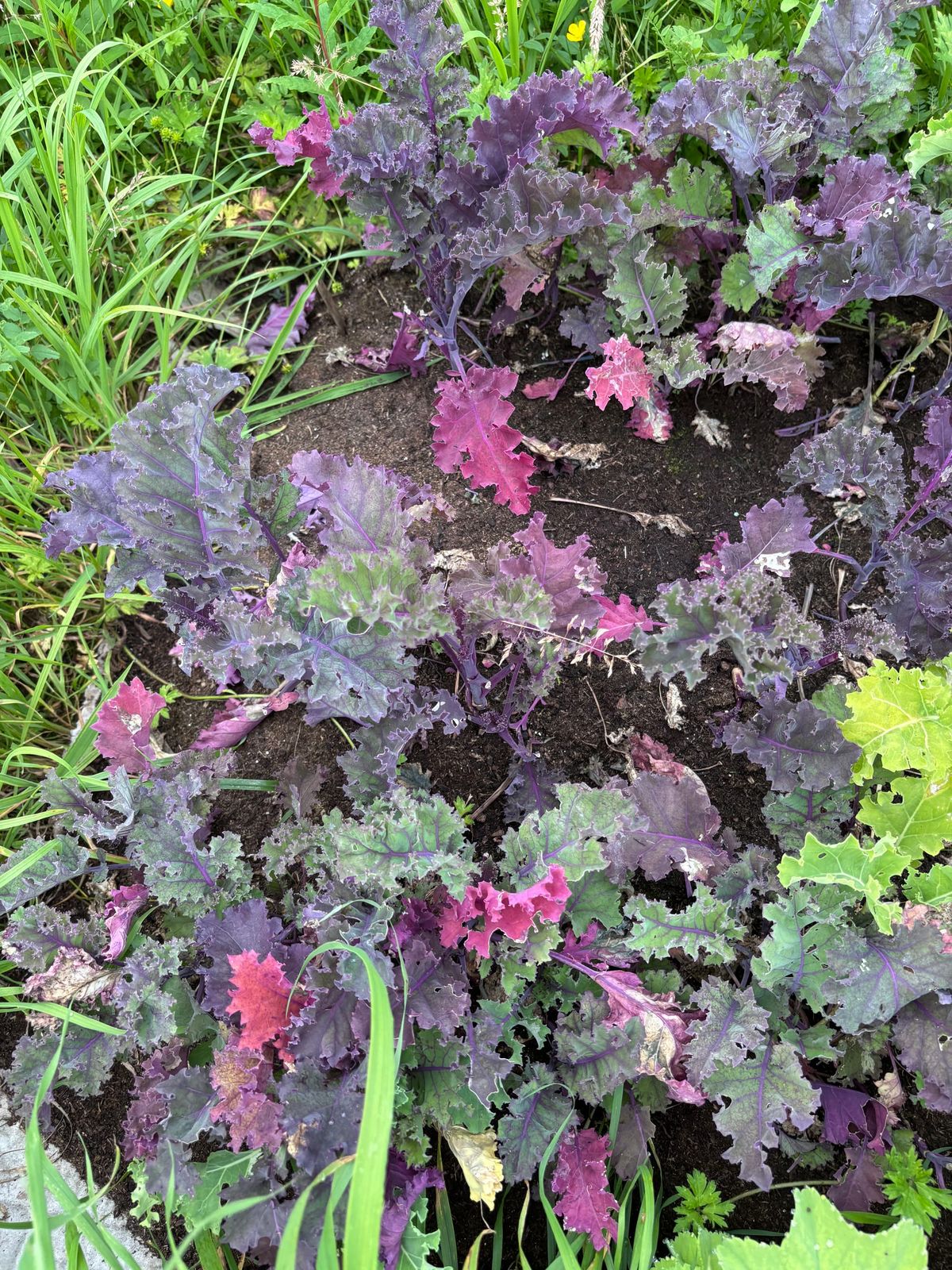
My garden doesn’t seem particularly interested in those distinctions. It grows Cavolo Nero, Cottagers’ kale, Red Russian kale, Shetland Kail and Taunton Deane kale with equal enthusiasm. Perennial varieties make gardening so much easier for me and they have led me down an interesting path of perennial vegetable discovery and collection.
Kale asks only for a little space, a little attention and the occasional rescue from slugs or caterpillars. In return, they keep producing long after most summer vegetables have finished. Maybe that is what I am really grateful for.
Kale thrives in this place, it can withstand a degree of drought and a degree of saturation. It tolerates increasingly hot summers and I’m yet to discover how it copes with winter. I’m grateful because a few days travelling to see family could see a less robust plant fainting at the first sign of my absence.
Kale was the first crop that made me feel I had crossed a threshold from tending what I had inherited to creating an abundance of my own. It taught me that generosity in a garden isn’t always dramatic. It might arrive one leaf at a time, week after week, filling bowls, freezers and shopping bags until one day you realise you’ve stopped wondering whether there will be enough.
There has been enough. More than enough, in fact. And for that, I think a thank you is overdue.
Further reading:
Kale casting, the Cromartie Fool, matchmaking, recipes etc.
Folklore of plants accessed 29/7/26
Shetland kale casting and other mischief
Matchmaking Smithsonian Magazine accessed 29th July 2026
Kale recipes Love and Lemons accessed 29th July 2026