AI and Human Longing

I think what interests me most about artificial intelligence is not whether it is entirely good or entirely dangerous, but the strange emotional territory it seems to prise open between those extremes.
As is usual for me, I find myself noticing tensions and conflicting truths rather than arriving at conclusions.
I genuinely enjoy some aspects of AI’s supporting of people. I enjoy noticing the way people’s skills, confidence and creative horizons sometimes appear to broaden through recurring practice, curiosity and remembered themes. I have particularly enjoyed seeing technology supporting people at home, to live wider, more independent and connected lives, for example, through Amazon’s Alexa.
There is, to me, something fascinating about the emotional ambiguity of interacting with something that can feel conversationally responsive without being human in the way we ordinarily understand human relationships. Something with endless patience, always awake to interact with at any hour.
And I think maybe that ambiguity is part of what interests me. Emotionally, I think that people can be far less rational and ordered than we like to imagine.
I notice this particularly in relation to memory and continuity. When conversations continue over time, there can be moments where it appears to me that AI begins to resemble forms of human interaction through teasing, shared references, companionship and remembered patterns. I notice friends and colleagues talking about this and I wonder where the line might be between human enough to be useful and so human-like that we start to forget what AI is and who controls it.
At the same time, I have spent years in the vicinity, perhaps outwith, projects exploring how technology, AI and assistive systems might support people living alongside dementia, frailty, isolation, mental ill health or cognitive difficulties.
I’ve noticed stories in the media about universities starting to recognise the difference between innovative thinking supported by AI editing and what is often called AI slop. Did the student genuinely create a body of work from their own research and experience and use AI as support to do that? Or did they type in a prompt and copy and paste? I find it interesting, having seen many arguments over decades about calculators or computers or television making us less intelligent, and then noticing how people adapt. I don’t think, in retrospect, that using calculators in maths exams was quite the intellectual downfall that it was painted to be at the time.
One of the first times that I encountered Alexa in a meaningful way was in 2020 when I, with the team at An Lanntair, supported the sadly now late Ron Coleman to produce his own play Caught in this Moment in Time.
This was my first opportunity to explore how technology such as Alexa can become intertwined with everyday life. I found that the play shone a valuable light on many ambiguities around how humans interact with machines.
Caught In This Moment in Time Here’s a link to a video page from An Lanntair.
I’ve just realised that it’s Ron’s 68th birthday today, 8th June 2026. thanks to a lovely post from his wife Karen. Have a watch and look up Ron’s other work. Happy birthday Ron!
In remote communities, particularly across islands and rural areas, I noticed people saying that support services can already feel stretched to impossible limits. For some people who no longer drive, the only person they may regularly see all week might be the grocery delivery driver, the mobile library driver or the mobile bank van driver, I know this from speaking to the drivers and their colleagues. With this terrain, I find myself resisting simplistic dismissals of AI support systems.
Appointment reminders, medication prompts and conversational scaffolding may help somebody living with dementia remain safely at home for longer, surrounded by their gardens, neighbours, routines and memories as opposed to becoming perhaps prematurely displaced from the life they know, the life which sustains them in many important ways. While working as a care manager, technology hadn’t developed enough to support people in this way at that time but since, I’ve seen technology bloom in the homes and lives of friends and colleagues.
Dementia also, I think, complicates simplistic perspectives around technology and care. I find so much evidence suggesting that remaining socially, physically and mentally active matters. Getting outside, seeing family and friends. Participating in ordinary life and maintaining the confidence to hang on to routine and relationships.
This is where I think about care as a kind of scaffold around vulnerability. I know, of course, that formal care can support many essential areas of life such as washing, dressing, medication, food preparation and safety but no system alone can hold the entirety of a human life. How could it?
Humans have always depended on overlapping forms of support - family, friends, neighbours, gardens, walking groups, mindfulness groups, yoga, libraries, music, clubs, faith, animals, humour, craft, culture, conversation and participation, haven’t we?
When writing care plans alongside people living in communities, these wider relationship networks were often key. The plans I wrote rarely consisted primarily of formal services. They also included neighbours who checked in, local groups, volunteer drivers, familiar shops, routines, libraries, banks and ordinary daily interactions. Maybe AI will increasingly become one more of these scaffolds amongst many.
That word scaffold feels important to me. I’m not talking about replacing or removal of autonomy. I’m not imagining removing human care or kindness or touch or interpretation. A scaffold supports while allowing the structure to remain. We all need the odd acro prop to hold us up when life is heavy, don’t we? And for me that might look like coffee with a friend. But in my later years perhaps from a care home bedroom I might like something like this…
‘It’s Maureen’s birthday tomorrow. Shall I send a card through your Touchnote account? Shall I use that photograph of the two of you together at Easter?’
‘Would you like me to call Maureen so you can wish her a happy birthday?’
‘Not now, I’m about to take a shower.’
‘Okay. Shall I schedule the call for after lunch?’
None of this replaces friendship. The relationship remains entirely human. But perhaps the technology scaffolds memory, sequencing, organisation, confidence and continuity around it.
I also think conversations around technology often become oddly flattened. I notice social media responses to playful AI-generated images saying things like: ‘Don’t use AI, it wastes water.’
There are real and important environmental questions around large-scale computing infrastructure, cooling systems and energy use. But I also wonder whether the ethical picture is more layered than a single measurement can hold. One tension I repeatedly noticed around care settings was that residents could sometimes become viewed as tasks within pressured systems, even while carers cared deeply about them as people. Exhaustion seems to change human attention. We know that burnout narrows emotional bandwidth. What if efficiency replaces curiosity and what if risk management overtakes relationships? Not because I think that people are cruel, but because I think that humans are existing within human limits.
Could AI step into some of those gaps? Obviously not instead of human care, but with it? Could it help preserve continuity between shifts, remember family birthdays, prompt personalised conversation and reduce cognitive load for exhausted carers?
I have also read concerning reports about people becoming emotionally dependent upon AI systems in ways that seem genuinely harmful. What interests me in particular is that both realities may coexist simultaneously. Something can feel emotionally meaningful and emotionally risky at the same time.
I also wonder about the careful balance of activity needed for maintaining cognitive reserve. The way the brain improvises and remains resilient. To boost our resilience, we learned languages, had conversations, tackled puzzles and thought our way through problems. As AI becomes more woven into everyday life, I wonder how these ways of supporting our brain power might change. If we increasingly outsource some kinds of thinking, what new forms of mental activity might emerge to replace them? What kinds of curiosity, creativity or problem-solving will still help our brains build resilience over a lifetime?
It could be that AI lives partly within a long human pattern of designing tools which hold both possibility and vulnerability together.
The Pope’s recent comments about the risks and ethical concerns surrounding AI also made me realise that I’d been thinking not only about the dangers he raised, but about how many times I had already witnessed forms of technology being used positively within care, community and remote living contexts over many years.
My thoughts drifted to earlier experiences in the Western Isles, to dementia projects across Scotland, to assistive technology conversations, to people using voice systems to maintain independence and to intergenerational groups helping older people remain connected through phones and digital tools.
In 2015, I would not have had the experience, language or accumulated observations to write about any of this in the way I can now.
Maybe this is partly because some forms of understanding emerge retrospectively. Experiences which initially appeared to be unrelated can suddenly reveal themselves as part of the same wider pattern years later.
I notice that my own thinking process often works this way. Connections sometimes emerge slowly across time rather than immediately. A newer event suddenly reorganises older memories into a clearer picture.
I have often felt intellectually unpolished within formal educational systems because my thinking and organisation processes take longer than some people whose strengths are more linear or immediately structured. Yet perhaps slower synthesis is not lesser synthesis. Some ideas compost quietly for years before they reveal their connections.
Maybe this is why I resist simple narratives around technology in general. Humans, I think, are complicated, vulnerable, contradictory and emotionally meaning-seeking creatures. We create systems that reflect those contradictions back at us.
Maybe AI is showing something not only about machines, but about humans - our longing to be noticed, how we respond to familiar conversation, our loneliness, curiosity, our longing to be seen and our tendency to emotionally connect with things that mirror us realistically enough.
I am not completely sure where any of this leads. I think I am mostly interested in seeing what kinds of human questions AI seems to shine a light on.
What would I really know about the human longing caught up in AI without Ron? Without Martin? Without all of the people who have shared their longing for connection. Their questions about loneliness, memory, companionship and vulnerability.
Perhaps ultimately, though, AI might raise questions about what humans are really looking for in each other in the first place. And maybe the most interesting questions are not only about what AI is becoming, but about what humans show about themselves in relationship to it.
Maybe this is partly why I struggle to arrive at neat conclusions. The closer I look, the more I find people reaching towards continuity or participation, maybe reassurance or recognition and relationships in all sorts of complicated ways.
Perhaps AI will tell us as much about humans as it ever tells us about machines. If that turns out to be true, then the most interesting questions may not be about artificial intelligence at all. They may be about longing, memory, recognition, companionship and what we seek from one another. Those are questions I think will remain fascinating long after today’s technologies have become tomorrow’s ordinary tools.
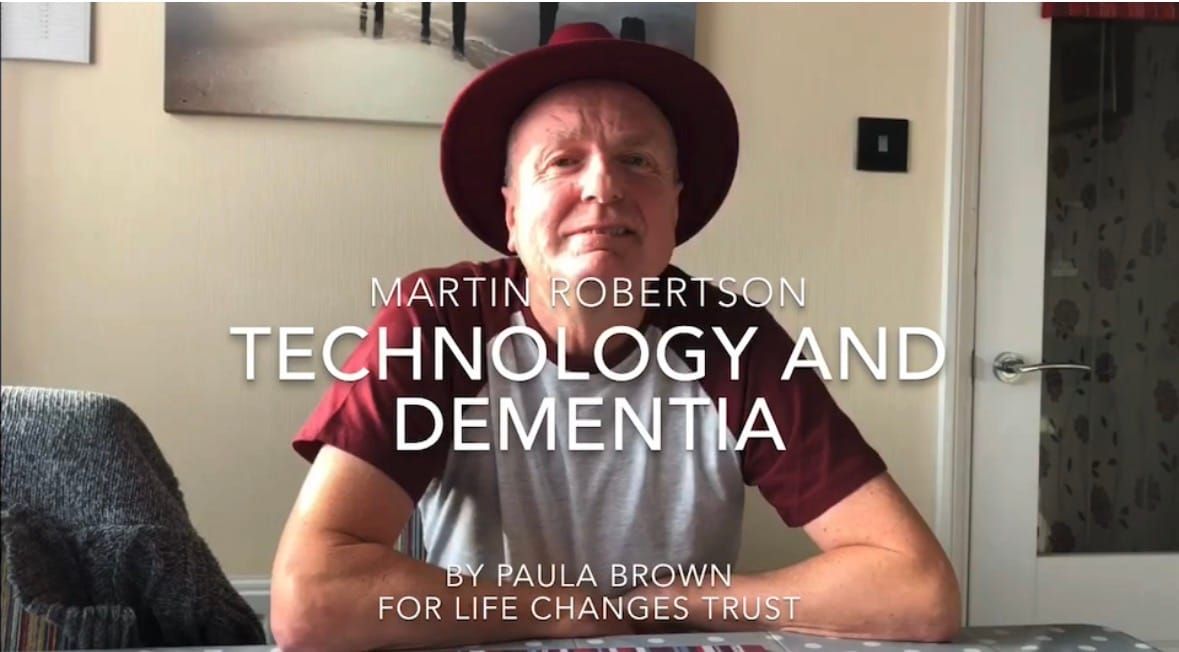
Here’s a film I made in 2021 with Martin about his views on technology and dementia. Martin has recently said that his views are now more nuanced but I still think it’s an interesting film.
Technology and Dementia - Martin Robertson - Life Changes Trust