Feverfew

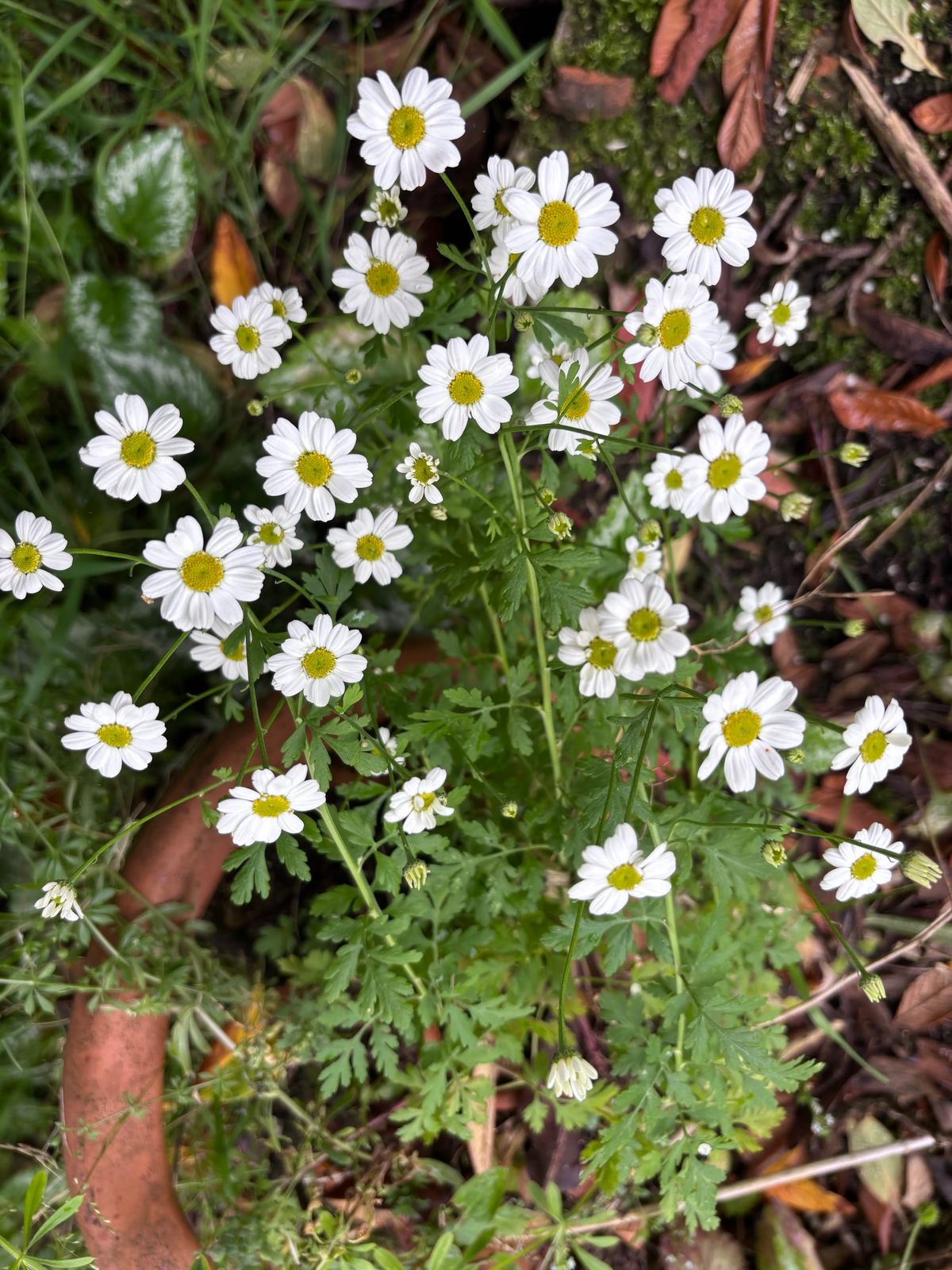
While waiting to see what might pop up in my garden over the first year, I noticed a terracotta pot with a broken rim, tossed over the pot as though it had created its own game of hoop-la. There didn’t seem to be anything in the pot in early spring but as summer approached, a mass of daisy-like flowers appeared and I needed to deploy the plant identification app.
Feverfew. There had been no need to buy the seeds that were on their way to me already. The feverfew in this pot was part of the reason that I decided to start the physic garden.
I dried some flowers for tea over the summer and my husband Dave tried it in tea when he had a slight fever. He has been developing quite the apothecary cupboard, of late. The fever passed quickly without any exciting developments. It might have been the feverfew’s doing or his own immunity. I like to think that the feverfew helped. It certainly had him sweating it out overnight!
I’ve been collecting folklore and origin stories about feverfew, alongside discovering what it has been used for over the years. Did you know that there’s a legend relating to the Parthenon? No?
Apparently, Ancient Greeks called the plant parthenium because of a legend that it was used to save the life of a worker who fell from the Parthenon during its construction in Athens.
Common uses are listed as reducing fever, easing headaches, menstrual and digestive complaints.
Of course, there are the usual dubious claims such as warding off plague if you just plant it by your door. It might work - I have some by my back door and I remain, thankfully, plague free.
Similarly, feverfew was supposed to ward off elf - shot, mysterious stabbing pains caused by elves shooting arrows, or something like that. I’m not convinced that I’ve been used by elves for target practice. It might be because of feverfew’s protective effects.
William Thomas Fernie, writing in Herbal Simples in the late nineteenth century, records that feverfew was to be pulled with the left hand, the fevered person’s name spoken aloud, and the herbalist must not look behind them. Gosh. Why not? I couldn’t find a reference as to what might be behind the unfortunate herbalist. That which must not be seen.
They are cheery little daisy-esque fellas to have in the garden, whether you believe in elves or not. Surely it can’t hurt to have some medieval plague protection, either. As long as you don’t look behind you!
Further reading:
Gaia Professionals accessed 15th September 26?
Herbal Reality accessed 15th September 26
Blood and Spicebush accessed 15th September 26