Himalayan Honeysuckle

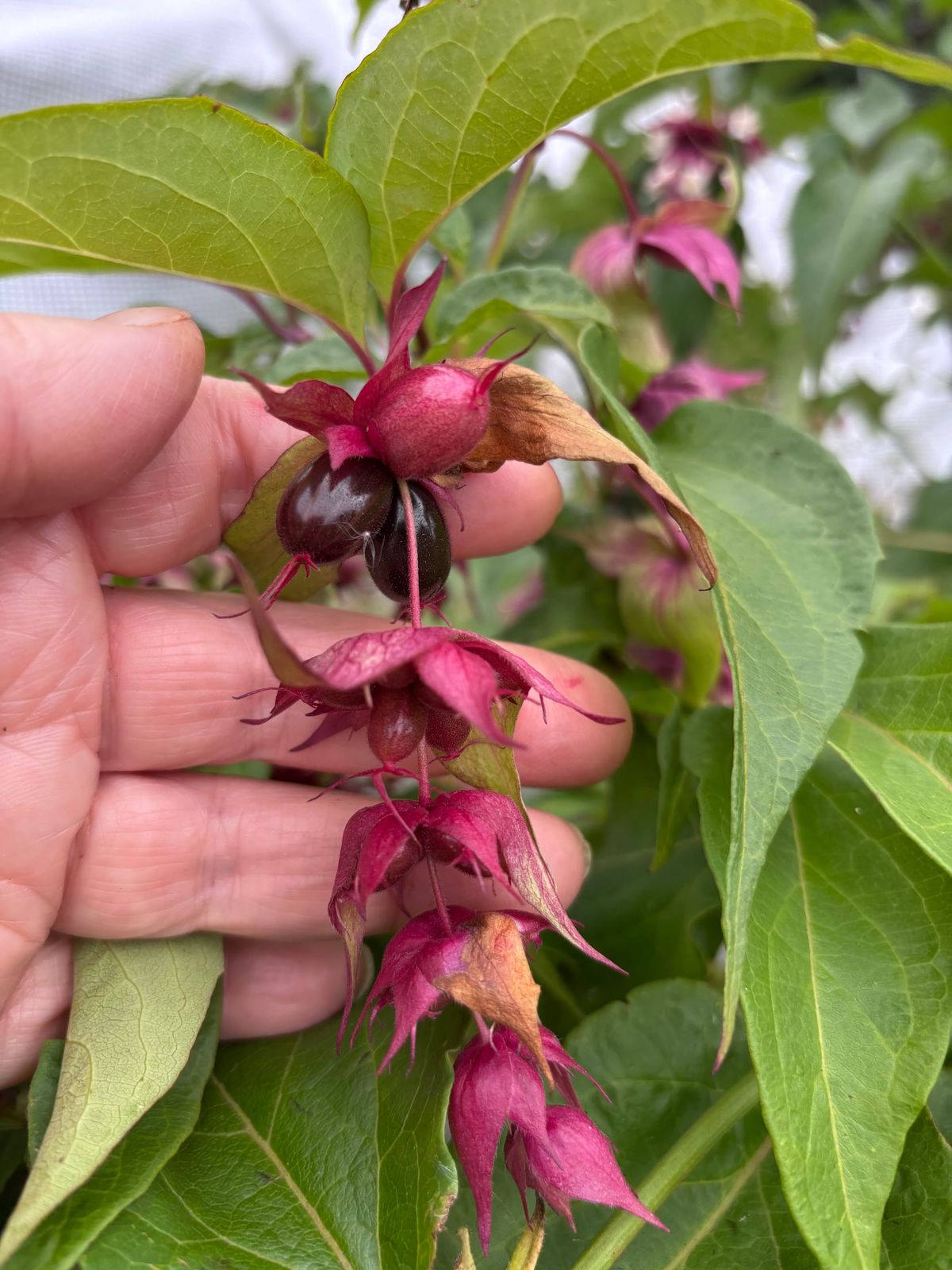
Pheasant berry or Himalayan Honeysuckle is Leycesteria formosa, in the honeysuckle family, Caprifoliaceae, and is native across the Himalayas into southwestern China.
Some say it’s worth tasting the berries before cooking with them as each plant seems to vary a little in flavour and some plants produce quite bitter berries, even when fully black, glossy and ripe. I’ve read that the best berries taste like something between bitter chocolate and figs, toffee and caramel. Ripe berries are very dark purple to black and fairly soft.
Picking up on the fig notes, they make quite good complex flavoured fig style pastes with sugar and a little water and go well in fig roll type biscuits, as a filling in thumbprint cookies, and as a filling in a bar type cake with a crumble topping, according to forager cooks.
But here’s the thing. The Royal Horticultural Society (RHS) doesn’t recommend it for eating at all and there has been a case where it is thought that cattle grazing on it met an unfortunately early end.
In traditional herbal remedies, the plant has been used for blood circulation, bleeding, jaundice, arthritic pain, asthma, menstruation, cystitis and fractures. I wouldn’t know about this as fortunately, I don’t have problems with any of those conditions. Let me know if you’ve tried it.
It’s a great plant to have in the garden anyway, to offer berries to birds in the autumn and for supporting pollinators earlier in the year. It doesn’t seem to need much assistance, as it’s thriving without any input from me whatsoever, here in Scotland, so I can only assume it’s fairly hardy. Being fairly hardy and fairly swift to spread, the plant is considered invasive in some areas, for example New Zealand and Australia, so it’s worth checking in your area.
I’ve been delving into the history of the plant and its uses, as befits my curiosity. I have been reading about how it was introduced to the UK around 1824 and it became popular on Victorian estates to cover pheasants and that those pheasants particularly enjoyed the berries.
The stalks have been used across the world to make simple flutes and the wind whistling through them has been described as a ghost flute, which I find quite fun.
This plant arrives in the UK as an exotic Himalayan ornamental, becomes useful pheasant cover on Victorian estates, travels to broader landscapes, feeds birds and pollinators, hangs out in the kitchens of foragers as a caramel-flavoured fruit, appears on the RHS website, labelled “do not eat”, and still carries an entirely different history as a medicinal plant and turns up as a spooky ghost flute thousands of miles away.
Leycesteria formosa, I like you. You belong in the physic garden. And maybe as a Halloween decoration. Musical. Possibly dangerous.
Further reading:
Plants of the World online accessed 22nd August 26
RHS accessed 22nd August 26
Wikipedia accessed 15th August 26
Totally Wild UK accessed 15th August 2026