I, Borage, Always Bring Joy

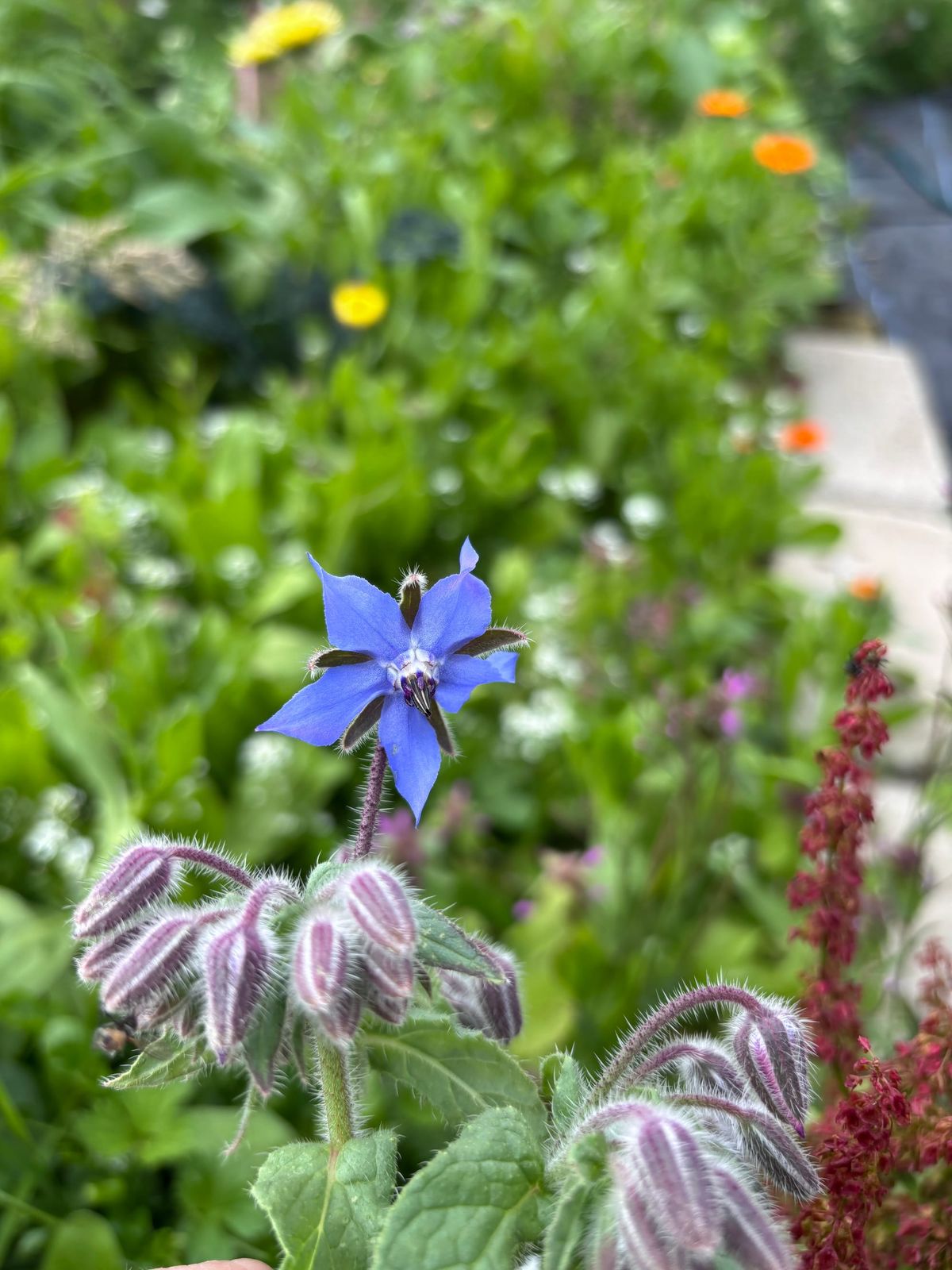
I first grew borage at Brownhill Cottage as an experiment. I wanted to see how well it would grow in the Scottish climate and to explore how much of the plant could be useful. The spectacular blue flowers decorated dishes and found their way into floral salads, while I cooked the young stalks as a vegetable.
I have discovered through growing plants and entering a relationship with them that almost every one of them becomes more complex, the closer I look. Borage is no exception. I am returning to it now because I am growing it in the developing physic garden, and I am exploring each of the plants I include there. Where each plant came from, what people once believed about it, how it was used, what chemistry has since been discovered around it, and which old questions science has returned to asking.
Borago officinalis is an annual of the borage family, Boraginaceae. Its native range is given by Kew as the western and central Mediterranean, including parts of southern Europe and North Africa. Britain lies within its introduced range. From that Mediterranean beginning it has travelled widely.
Its own name has accumulated stories almost as readily as the plant sets seed. One of the loveliest appears in an old Latin rhyme:
Ego borago, gaudia semper ago.
Literally, approximately, “I, borage, always bring joys.”
Gaudia is the plural of gaudium, joy or gladness, while ago can carry doing, producing or bringing about. “I always bring joy” sits naturally within the Latin. I knew those after school Latin classes would come in handy, eventually.
By 1858 Lady Caroline Catharine Wilkinson was quoting the line in Weeds and Wild Flowers: Their Uses, Legends, and Literature. Her entry for borage begins with Ego borago gaudia semper ago, followed by what she calls the old English version: “I, Borage, Always bring courage.”
Where the Latin rhyme first appeared is harder to pin down. It has travelled through later herbal literature and is sometimes pushed towards Pliny and Roman antiquity, yet I have not found a source showing that Pliny himself wrote those words. I rather like leaving that uncertainty intact. Here is a sentence which has been carried from one herbal writer to another, translated between joy and courage, gathering history as it went.
The association between borage and the spirits of the person taking it certainly became deeply established. Later herbal tradition places it with plants associated with gladness, consolation, the heart and melancholy. John Gerard’s great Herball, first published in 1597, belongs to that tradition, while Nicholas Culpeper’s seventeenth century herbal continued to treat borage as a cordial herb.
There is also a common story that borage travelled into battle. Roman soldiers are said to have drunk borage steeped in wine before fighting and medieval knights are sometimes said to have worn or swigged it for courage. These stories appear frequently in herb lore, yet their exact documentary origins are much harder to establish than the later herbal references. I would rather keep them as folklore than tidy them into historical fact. What can safely be said is that borage acquired a long lasting reputation for courage and cheerfulness, and that wine, gladness and the relief of melancholy gather around it in the European herbal tradition.
Then, many centuries after people began attaching courage to the plant, laboratories started asking another question. Could anything in borage genuinely alter the behaviour of damaged or malignant cells? The answer, so far, is interesting. Interesting to me, anyway, and I’m about to take a slightly uncharacteristic deep dive into research because the subject aligns with some of my past work.
In 2013 researchers published experiments on borage seed oil and gamma-linolenic acid, shortened to GLA. Borage seed oil is especially rich in GLA, an omega-6 polyunsaturated fatty acid. The researchers tested both borage oil and isolated GLA against human HL60 promyelocytic leukaemia cells grown in culture.
The cells were exposed for seventy two hours and their survival measured. Both the whole oil and GLA showed cytotoxic activity against the leukaemia cells.
They were also interested in DNA damage. Using fruit flies as a living experimental system, they exposed the flies to hydrogen peroxide, which creates oxidative genetic damage, and then examined whether borage oil or GLA altered that damage. Neither borage oil nor GLA itself produced a significant increase in mutations under their test conditions. When given alongside the damaging agent, both showed antigenotoxic activity, reducing the genetic damage the test detected.
That creates an intriguing pair of observations. In one experimental setting material derived from borage reduced the survival of human leukaemia cells. In another it appeared to protect genetic material against an induced source of damage.
I find this part of the research difficult to read without discomfort. Drosophila are a standard experimental model, but that does not make me indifferent to the fact that living creatures were deliberately exposed to a damaging agent in order to measure the effect.
In 2016 researchers returned to the plant itself. This time they used edible leaves and petioles from wild and cultivated Borago officinalis plants. They also investigated three phenolic compounds found in the plant: rosmarinic acid, syringic acid and sinapic acid. Again they used HL60 human promyelocytic leukaemia cells.
The researchers found a clear concentration dependent cytotoxic effect. The amount of plant material required to reduce cell survival by half, the IC50, was 0.49 mg/mL for the wild plants and 0.28 mg/mL for the cultivated plants.
Then they began taking the plant chemistry apart. Rosmarinic acid itself showed substantial activity, with an IC50 of around 0.07 mM. Syringic and sinapic acids were considerably less impressive when tested separately. Yet a mixture containing the principal phenolics was more potent, with an IC50 equivalent to around 0.04 mM rosmarinic acid.
That may be one of the most interesting observations in the borage story. The mixture was more potent in this experiment than rosmarinic acid tested alone. A medicinal plant is a chemical community. Pulling out one molecule can tell us a great deal, but occasionally the conversation between molecules matters too.
The researchers again investigated DNA protection using Drosophila. Borage material and some of its phenolic components reduced the genetic effects produced by hydrogen peroxide. They described these findings as antigenotoxic activity.
None of this means that borage has been shown to prevent or treat cancer in people. These were laboratory cells and fruit flies. No clinical trial has demonstrated that eating borage, drinking it, or taking borage oil treats cancer. The distinction matters, but it does not make the laboratory findings less interesting.
In fact, the story becomes more complex once GLA is followed beyond borage. This was very interesting to me because I worked in cervical cytopathology for ten years and qualified with the BSCC Certificate of Competence in Gynaecological Cytopathology in 1991.
Researchers had already discovered during the 1990s that sufficiently high concentrations of GLA could induce apoptosis in cultured human cervical cancer cells. Apoptosis is one of the body’s ways of disposing of a cell. Cancer cells often acquire the ability to evade this machinery and continue dividing when an ordinary damaged cell would stop or die.
In a 1996 study of HeLa cervical cancer cells, 50 micrograms per millilitre of GLA produced structural changes characteristic of apoptosis and fragmentation of the cells’ DNA. At that concentration GLA also reduced MAP kinase activity, and the researchers investigated associated changes in the regulatory proteins c-Jun and c-Myc.
GLA subsequently became interesting in breast cancer research. A 2004 study exposed several human breast cancer cell lines to GLA alongside the chemotherapy drug docetaxel. GLA increased docetaxel’s cytotoxic effect. The researchers also found that GLA markedly reduced expression of the HER2/neu oncoprotein in one of the breast cancer cell lines, with HER2/neu messenger RNA falling in a concentration dependent way.
HER2 is particularly interesting because in some breast cancers the HER2 gene is overactive, producing large quantities of a growth promoting receptor and helping drive the cancer.
Here was a fatty acid abundant in borage seed oil apparently interfering with that signalling system in cultured cancer cells. Another proposed mechanism involves the voracious appetite some cancer cells have for making fats.
Rapidly growing tumour cells need enormous quantities of membrane material and other lipids. Some greatly increase an enzyme called fatty acid synthase, or FASN, to help supply them. Researchers have proposed that high concentrations of GLA can interfere with this altered metabolism, allowing malonyl CoA to accumulate, suppressing fatty acid oxidation and contributing to an energy crisis inside susceptible tumour cells. The idea is still experimental, but it offers one possible explanation for the sensitivity of some cancer cells to GLA.
Rosmarinic acid has developed a research life of its own too. It occurs in several plant families, including Boraginaceae, and has now been studied in numerous cancer models. Reviews of this research describe effects on cancer cell proliferation, apoptosis, invasion, migration and signalling pathways. Most of that evidence is preclinical, and problems such as poor bioavailability stand between an interesting molecule in a laboratory and a useful drug in a person.
And the story is still moving.
In 2026 S. Karsavran, B. Çelik and S. Mesci published Evaluation of cytotoxic, antioxidant, anti-inflammatory and apoptotic activities in seed oil of Borago officinalis L. (Borage) using human cancer cells in the South African Journal of Botany. The paper specifically examines borage seed oil across human cancer cell models, looking at cytotoxicity, antioxidant and anti-inflammatory effects and apoptosis. It is striking because the researchers have returned to the oil itself rather than studying GLA in isolation.
So borage has arrived in a somewhat unexpected place. A plant whose old literature talks about gladness and melancholy is now being examined through DNA damage, apoptosis, oncogene expression and cancer cell metabolism.
There is another part of its chemistry which deserves to be in the story. Borage can contain pyrrolizidine alkaloids, some of which are capable of causing serious toxicity, particularly to the liver. The existence of interesting laboratory activity therefore does not make unrestricted medicinal consumption sensible. The 2016 researchers themselves acknowledge the need to consider the plant’s potentially harmful constituents alongside its useful ones.
That complexity is one of the reasons I wanted a physic garden. The plants in it do not divide neatly into poisons on one side and medicines on the other. Their chemistry is full of consequences, some useful, some dangerous, some still poorly understood. Wolfsbane is an obvious example. People have spent centuries observing the consequences of plants and attaching stories to them. Science gives us different tools with which to return to the same plants and ask more specific questions.
With borage, those questions have become ambitious. Why can extracts of its leaves reduce the survival of cultured leukaemia cells? Why does a mixture of its phenolic compounds behave differently from the individual compounds? How does its seed oil interact with DNA damage? Why can GLA trigger apoptosis in certain cancer cells? Could its effects on HER2 or altered fat metabolism eventually reveal something useful for cancer treatment?
At present, these questions belong largely in the laboratory and that is enough to make them worth asking.
And meanwhile, in the physic garden, Borago officinalis continues doing what it has always done, producing rough leaves, shocking blue stars, and abundant seed.
Ego borago, gaudia semper ago.
I, borage, always bring joy.
Unless you happen to be a fruit fly.
Further reading
Wilkinson, Caroline Catharine, Weeds and Wild Flowers: Their Uses, Legends, and Literature. London: John Van Voorst, 1858. Borage entry, p. 147 onwards. (Internet Archive)
Royal Botanic Gardens, Kew, Plants of the World Online: Borago officinalis L. Accessed 12 August 2026. (Plants of the World Online)
Lozano-Baena, M-D. et al. “Cancer Prevention and Health Benefices of Traditionally Consumed Borago officinalis Plants.” Nutrients 8, no. 1 (2016): 48. DOI 10.3390/nu8010048. (Europe PMC)
Tasset, I. et al. “Protective Effect of Borage Seed Oil and Gamma Linolenic Acid on DNA: In Vivo and In Vitro Studies.” PLOS ONE 8, no. 2 (2013): e56986. (PLOS)
de Kock, M. et al. “The induction of apoptosis in human cervical carcinoma (HeLa) cells by gamma-linolenic acid.” Prostaglandins, Leukotrienes and Essential Fatty Acids 55, no. 6 (1996): 403–411. (PubMed)
Menendez, J. A. et al. “Omega-6 polyunsaturated fatty acid gamma-linolenic acid (18:3n-6) enhances docetaxel cytotoxicity in human breast carcinoma cells: Relationship to lipid peroxidation and HER-2/neu expression.” Oncology Reports 11, no. 6 (2004): 1241–1252. (PubMed)
Karsavran, S.; Çelik, B.; Mesci, S. “Evaluation of cytotoxic, antioxidant, anti-inflammatory and apoptotic activities in seed oil of Borago officinalis L. (Borage) using human cancer cells.” South African Journal of Botany 196 (2026): 599–609. DOI 10.1016/j.sajb.2026.06.032. Accessed 12 August 2026. (EurekaMag)