Take Medlars That Be Rotten

I bought a medlar tree this week. I don’t have childhood memories of it aside from hearing about it in passing in old gardens or country estates. I have still never tasted one. Honestly, I bought it because I was curious. I’m just unappeasably interested in ancient flavours and unusual, perennial plants.
The curiosity began with a conversation with a brilliant country estate Head Gardener, who mentioned that it had a bawdy name and that the fruits need bletting before use. Someone else mentioned the medlar in passing, along with a piece of folklore and a reputation that seemed oddly disproportionate for a small fruit tree. The more I read, the odder it seemed. Dutch art references to prostitution? Male boasting? These curious clashes always intrigue me. Of course, I had to look up the naughty names for medlars. Wow. I’m not going to share them here.
I found a positive reference to medlars. In folklore, in France, according to a Royal Horticultural Society article, the medlar was believed to be protective, to possess magical powers to protect against witchcraft and sorcery.
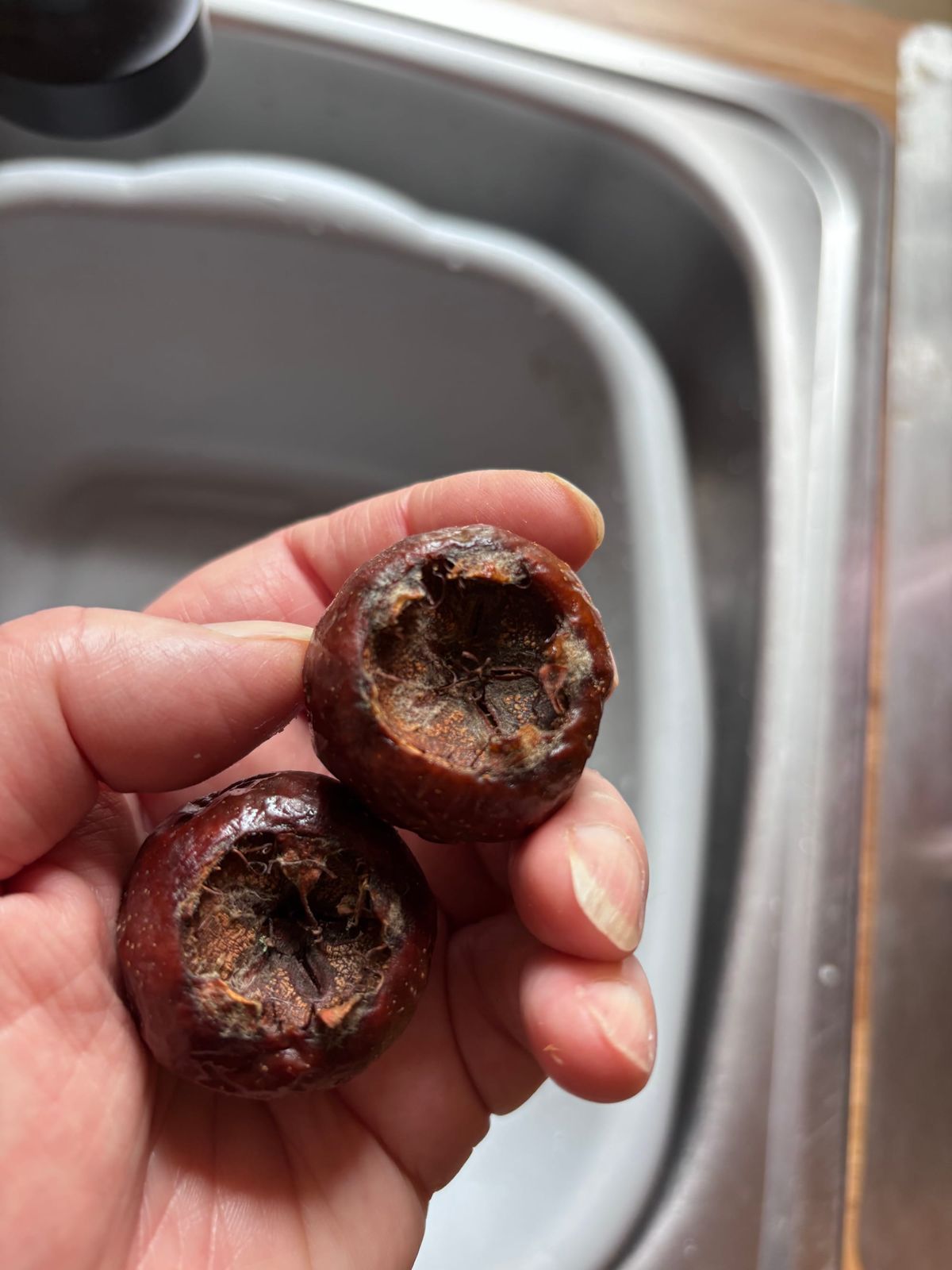
Unlike most fruit, medlars are not eaten when they first look ripe. They are harvested after a good frost and left to soften. The process is known as bletting. The fruit might seem to be spoiling. The flesh darkens, the texture softens, the way that a plum might begin to rot. By the time it is considered ready to eat, people unfamiliar with the fruit might assume it had gone past its best but with the medlar, that is exactly the point.
For centuries, medlars were common enough that perhaps nobody thought this to be unusual. A Tudor recipe instructs cooks to “take medlars that be rotten” with no further explanation. Maybe there was no need, maybe in that era, everybody knew what ripeness in medlars looked like. Or maybe everybody knew what ripeness did not always look like.
I found myself unexpectedly gripped by this idea. The medlar seemed to be asking a question that extends beyond fruit. What if we have mistaken appearance for readiness?
I wonder if we carry assumptions about what flourishing, maturity or ripeness should look like. Do we expect confidence, certainty, productivity and noticeable achievement? Do we assume that value will announce itself clearly in a socially recognisable way? I keep noticing that some things reveal themselves more slowly.
A skill learned through years of repetition might be difficult to explain in words. Understanding may emerge years after an experience rather than during it. Friendships might deepen gradually through ordinary conversations. Ideas can sit quietly for decades before finding the language needed to communicate them.
The medlar seems to challenge the idea that value is always most visible at first glance. Maybe it asks us to reconsider what ripeness looks like. Perhaps that is why I felt drawn to it. Maybe the question is even more delicious than the fruit?
How do we recognise things that do not fit our societal expectations? What happens when our existing frameworks are insufficient? How do we respond when something exceeds the categories available to us? How do we measure value?
A fruit that looks unripe when picked and overripe when ready seems to sit naturally amongst such questions.
The medlar was once common, in home and kitchen and estate gardens and in recipes. Today it survives mostly in heritage collections, old gardens and the gardens of gardeners with an interest in unusual fruit. The tree has not changed but maybe our expectations have. There is something appealing to me about that.
A fruit can disappear from everyday life because it refuses to conform to the demands of convenience, transport and uniform appearance, even though the flavour might be really worth the effort. Can you imagine the risk assessments involved with supermarkets selling fully bletted fruit? Maybe some specialist shops do just this but I’ve never seen them for sale.
I have not tasted a medlar yet. The tree has not even arrived. Maybe in a few years I will be making medlar cheese in the kitchen or attempting a Tudor tart from a recipe written hundreds of years ago. I might discover that I dislike the flavour entirely. In writing this, my curiosity got the better of me and I tracked down some frozen medlars and bought them. They have just arrived.
For now, the tree represents something else, for me. Maybe a reminder that not everything valuable announces itself immediately. Some things require patience, participation.
And might some things only become fully themselves in our eyes, after we learn to recognise a different kind of ripeness?
References and Further Reading
- Dawson, T. (1597). The Good Housewife’s Jewel. Early modern English cookbook containing the medlar tart recipe beginning “Take medlars that be rotten and stamp them.”
- Royal Horticultural Society. Fascinating Facts: Medlars. Historical background, cultivation notes and references to medlar symbolism. (Accessed 21/6/26)
- William Shakespeare. As You Like It, Act 3, Scene 2. Reference to “the right virtue of the medlar” and the phrase “rotten ere you be half ripe.”
- The Good Huswifes Jewell. Various modern transcriptions and discussions available through historical food research websites.
- British Food: A History – Thomas Dawson and Medlar Tart - Discussion of the Tudor medlar tart recipe.
- Turnspit & Table – Medlar Tart Reconstruction - Recreation and interpretation of the Tudor recipe.
- RHS Medlar Feature Historical cultivation, folklore and literary references.
- Medlar recipes (Orchard Notes accessed 21/6/26)
- If you can’t wait… this is where I bought frozen medlars (Exotic Fruit Online accessed 21/6/26)
- I found a Russian document about dyeing with medlar bark and a microwave (accessed 22/6/26)
- Prostitutes in the Fruitbowl (Ridiculously Interesting accessed 22/6/26)
- How to grow medlars from seed (Horticulture.co.uk accessed 24/6/25)
- Tiptree sell an inexpensive medlar jelly (accessed 24/6/25)