The Honeysuckle outside the Bathroom Window

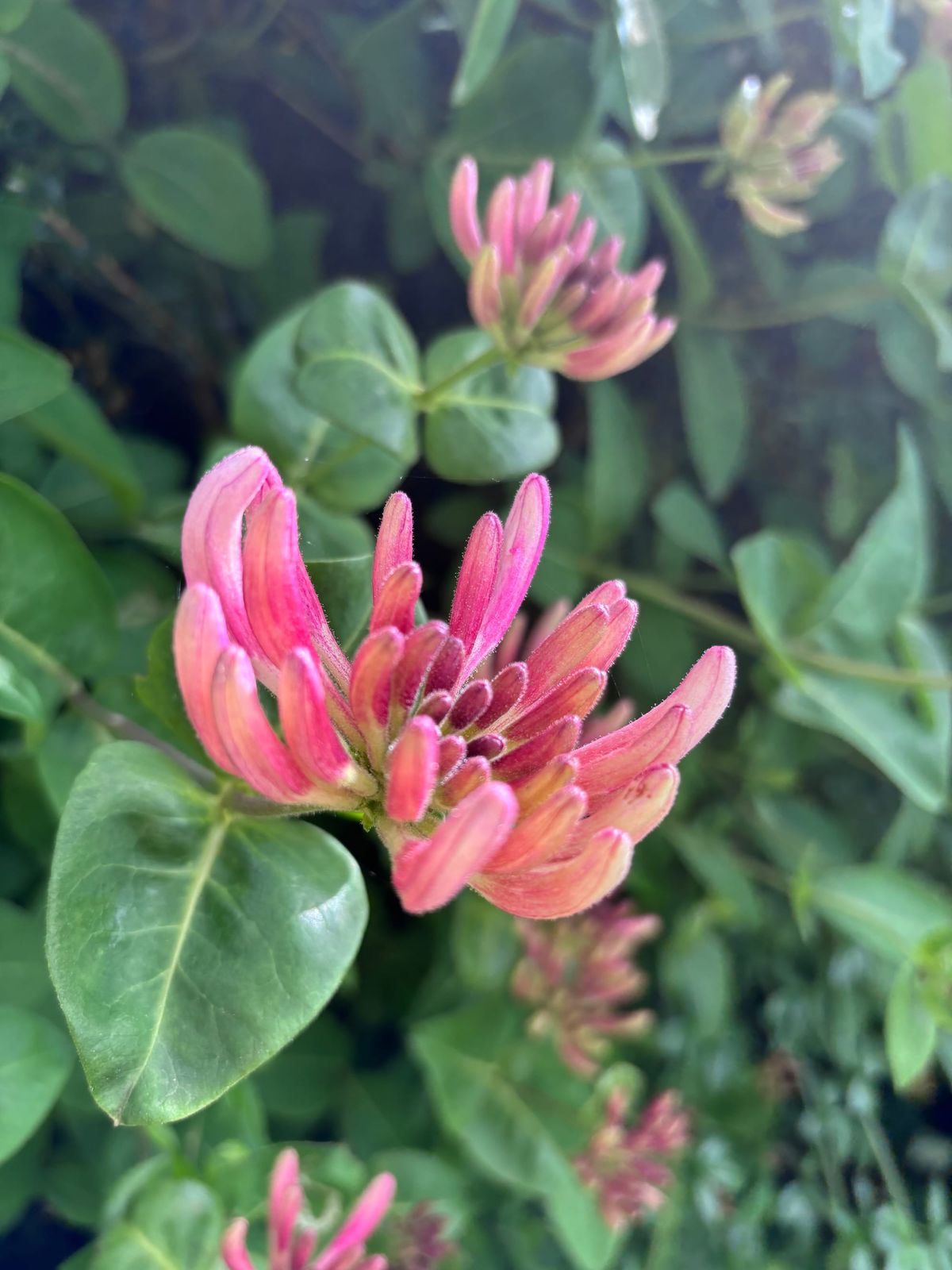
I have a honeysuckle growing outside my bathroom window. Maybe “growing” is too mild of a description. It has become an enormous presence, intertwined with a fuchsia and has advanced across the view so much that I can’t see out of the window at all. It flowers extravagantly and fills the air with fragrance. I tell myself I really ought to cut it back.
Before reaching for the secateurs, I find myself wondering what stories the plant carries. Should I check for folklore in case I need to ask permission?
The old Scottish name for honeysuckle is woodbine. One explanation suggests the name comes from its habit of spiralling around young trees and shrubs as it grows. Looking out of the bathroom window, I can see exactly what they mean. The honeysuckle and the fuchsia seem to have entered into a long-running conversation, each threading itself around the other.
As I read more about honeysuckle, the more entwined the stories look. My research suggests that honeysuckle has long been associated with love, devotion and fidelity. In Scottish folklore it was linked to weddings and to a form of affection that clings without harm. Across Europe, bringing honeysuckle into the home was sometimes thought to attract love, luck and prosperity. Yet in other traditions, young women were discouraged from bringing the flowers indoors because their fragrance was believed to encourage awakening dreams of love.
According to the Bach Centre, the honeysuckle state is associated with looking towards the past (sounds a bit like me…) and believing that the best days are there, rather than ahead (steady on, now…that’s not me at all).
I find that in folklore, it’s common to discover that the same plant could be considered fortunate, romantic, protective or slightly dangerous depending on who was telling the story or where the story was from.
A form of affection that clings without harm. I wonder if this is part of the connection that I have with the plants? With the old gardener? With my new perennial vegetables interest that I’m bringing to this place? A tiny connection between the ancient and the modern in my fascination with historical plants, food and stories?
The imagery of entwined lovers appears in medieval literature too. In the twelfth century, Marie de France wrote a short poem called Chevrefoil (French for honeysuckle) in which the relationship between honeysuckle and hazel becomes a metaphor for two lovers whose lives have become inseparable. The image persisted - anyone who has seen honeysuckle climbing through a hedge might understand the appeal. It is a plant that rarely grows entirely alone. Even the aroma seems made for a relationship.
The flowers are most fragrant in the evening. Walking through a garden at dusk, you can often smell honeysuckle before you see it. The fragrance seems to have evolved not for people but for moths, advertising nectar to pollinators that fly after dark. And yet we have been stopping to notice it for centuries.
As a child, I remember carefully pulling the flowers apart to taste the tiny drop of sweet nectar hidden inside. The nectar is safe in small quantities, although the berries and other parts of the plant are reportedly not edible. Across Britain, generations of children seem to have done the same thing, which may explain how the plant was given the name honeysuckle.
One detail captured my imagination. I came across a reference suggesting that when honeysuckle spiralled around young hazel rods, leaving a twisted mark in the wood, the stems were sometimes cut and used as walking sticks. Whether this was a widespread practice or a local tradition, I don’t know. But I love the image of a walking stick carrying the memory of two plants.
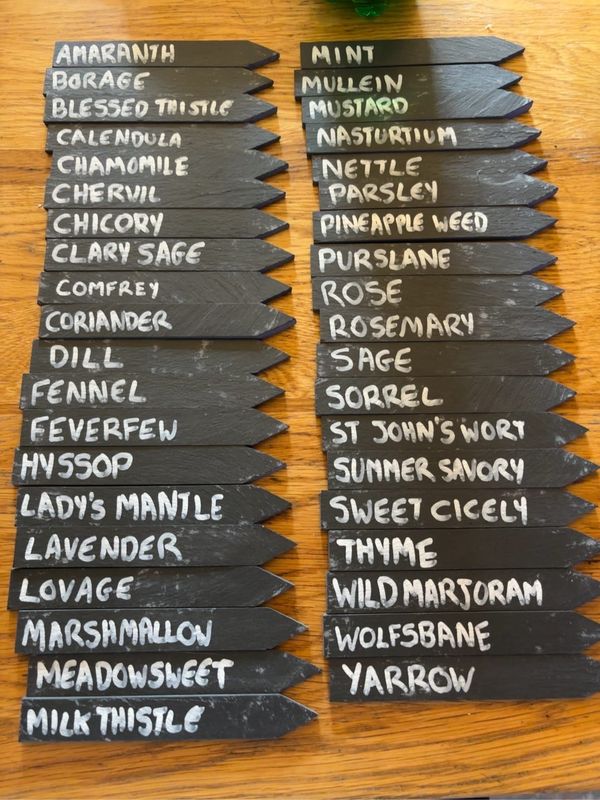
Maybe that is what I find myself noticing in this garden more generally. The previous gardener left traces everywhere. The elder trees, established shrubs, fruits, medicinal herbs. The stories neighbours tell me about the plants he valued. I never met him, but I encounter fragments of his interests every time I walk outside.
Now I find myself weaving my own curiosities into the same space, much like honeysuckle around a hazelnut rod. Medlars, perennial vegetables, ancient beans, unusual fruits and herbs. Plants that make me stop and ask questions. The honeysuckle is becoming part of that conversation too, even though it’s a common enough plant.
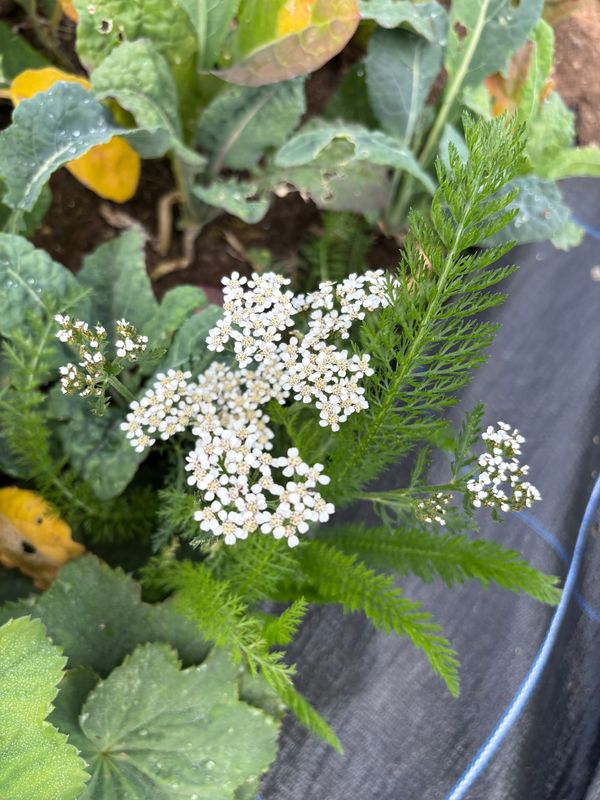
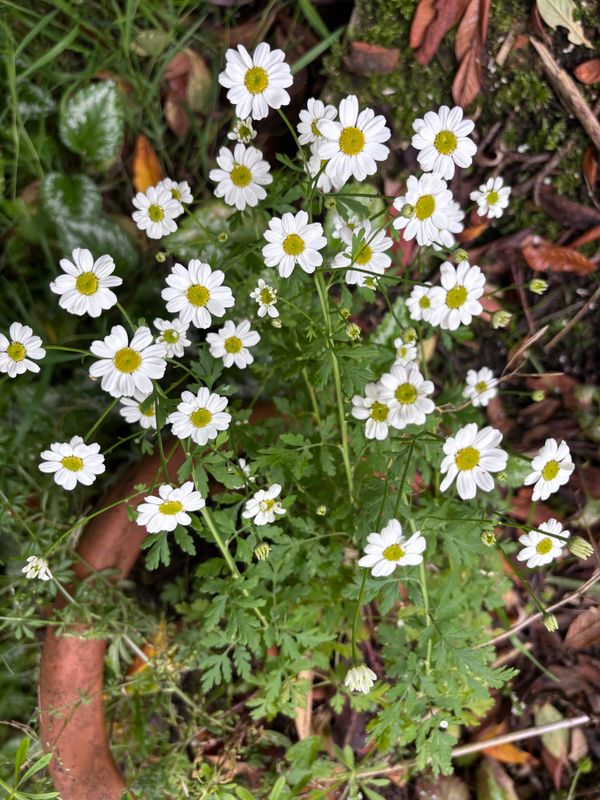
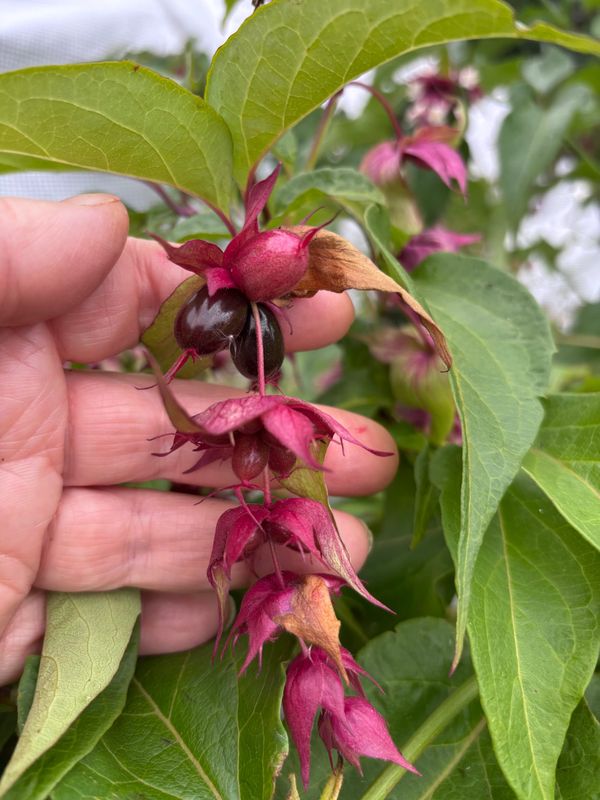
I’m getting to know the garden like a new friend. I didn’t arrive with the idea that this is my garden now, instead I’ve been watching and waiting and learning about what is here. And what a grand discovery it has been so far! Quince, feverfew, Himalayan honeysuckle, sweet cicely, lovage, plants I barely knew about before arriving here and a rich, meaningful reason to discover them all.
I still need to prune the honeysuckle. The bathroom window has disappeared beneath leaves and flowers. But before I cut it back, I wanted to know a little more about it.
Maybe that is one of the pleasures of gardening. Entering into relationships with plants. Learning their names, histories, folklore and preferences. Inheriting traces left by previous gardeners and adding a few of our own.
The honeysuckle will flower again next year whether I understand it or not but somehow it feels better to introduce myself first and start a conversation with a plant that was in this garden long before me. Much as I am entering into a conversation across time with the old gardener.
References
- Fareham Borough Council. Honeysuckle (Lonicera periclymenum) factsheet. Fareham Borough Council Honeysuckle PDF
- Highbury Wildlife Garden. Honeysuckle and folklore. Highbury Wildlife Garden Honeysuckle page
- Charnwood Foraging. Honeysuckle (Lonicera periclymenum). Charnwood Foraging Honeysuckle guide
- University of Cambridge, Plant-Lore Project. Tristan and Iseult’s Honeysuckle and Hazel: Marie de France’s Chevrefoil. Cambridge Plant-Lore Project article
- Bach Centre Flower Remedies honeysuckle page (accessed 26/6/26)