What Did Monks Know About Crab Apples?

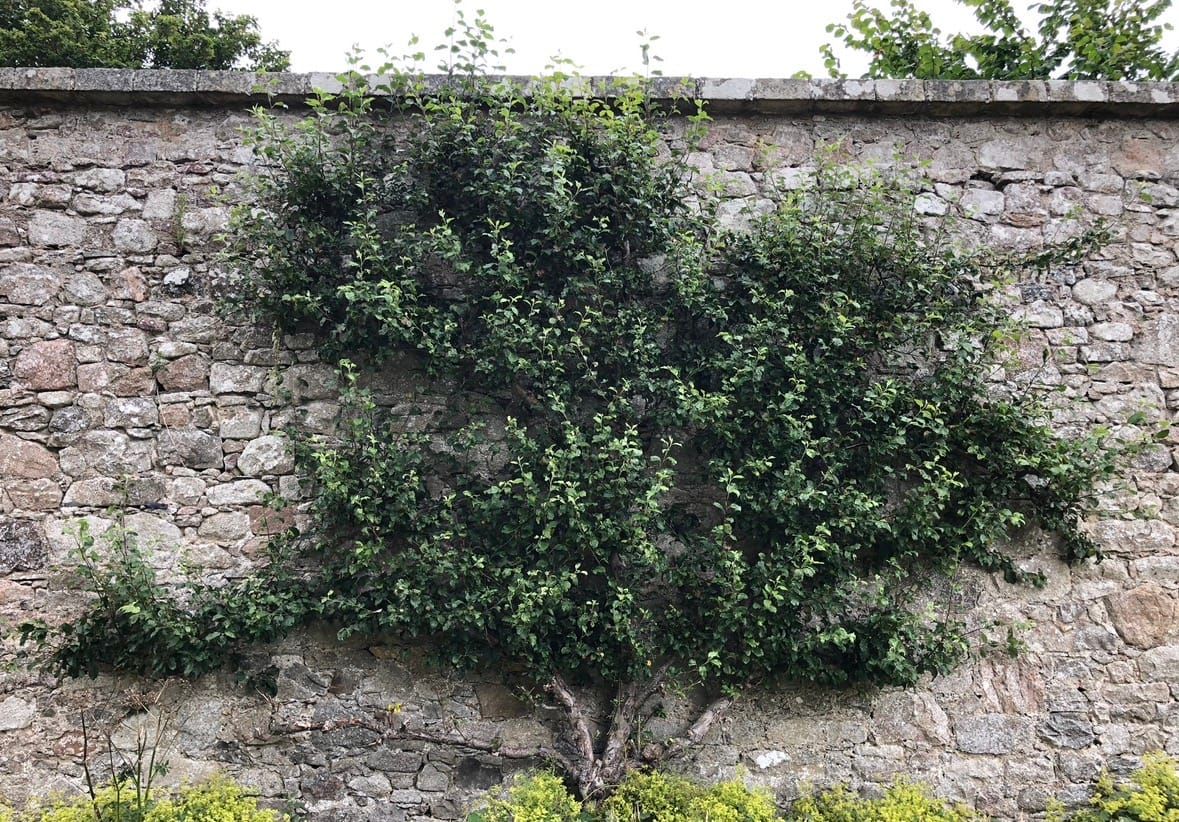
There is an old crab apple tree at Deer Abbey, in Aberdeenshire. If you look carefully, you can see how it started life being carefully trained against the stone-walled garden wall and then at some point, it just goes wild.
The abbey itself survives mostly as foundations, now. Stones tracing the outlines of buildings where monks once lived, worked and worshipped. Our old dog Dylan used to love exploring the foundations and steps. The Book of Deer survives too, carefully preserved, its pages protected behind glass. The tree remains outside.
I first noticed crab apples because my Dad had a tree. I remember my grandmother occasionally throwing a few into jam “for the pectin”. I had seen jars of crab apple jelly in country kitchens and on market stalls, but never paid them much attention.
Years later, living along the road from Deer Abbey, I found myself wondering about the old trees. The monks had trained the fruit trees into careful geometric forms against the walls. It must have taken years of pruning, shaping, discipline and attention. Valuable space was given over to them. Labour was invested in them. Generations cared for them. Why? What did they know about crab apples that we might have forgotten?
The answer might be surprisingly simple. They might have valued them because they were useful. Crab apples are rich in pectin. They can be preserved. They support pollinators. They can be turned into jellies, jams, drinks, vinegar and remedies. They thrive where less hardy fruit trees may struggle. But I wonder if there could be another answer.
Modern life often encourages us to value things that are immediately productive, profitable or convenient, doesn’t it? But the people who tended those trees might have understood value differently. They will have lived closer to seasons, weather, preservation and continuity. A tree may not only have been a source of fruit. Maybe it was an investment in future harvests, households and generations.
The Book of Deer tells us something about what the monks wrote down. It records prayers, Gaelic language, land grants and the history of the monastery. What it doesn’t tell us is what happened in the garden. I wonder why not?
Who taught the monks to prune the trees? Was it the novices who were tasked with this duty? What recipes were made from the fruit? How many conversations took place by the branches? What knowledge was carried in hands? These are the questions that remain, for me.
The older I get, the more interested I am in forms of knowledge that sit outside of records. The things learned by watching and helping, repeating and in participation. Someone who knows when a bannock dough feels right. The gardener who knows exactly when to gather fruit. A crofter who can read the weather from the sky. Knowledge that rarely appears in documents but survives in the doing. Maybe that is why I find the crab apple tree so interesting.
The abbey in its entirety is gone and so are the monks but the tree remains, flowering in spring, fruiting in autumn. Continuing through seasons that the people who first tended it could never have imagined. And the monks are only part of its story.
Probably long before and long after medieval monasteries, people attached meanings to crab apples. In Celtic folklore they were associated with the Otherworld, with immortality and enchantment. In parts of Britain they appeared in love divinations and seasonal rituals. Crab apple pips were thrown into fires to test a lover’s faithfulness. Peelings were tossed over shoulders in the hope of revealing a future spouse.
As I read more, the stories became stranger. They were thought to offer protection against sorcery. I came across references to magical apples granting eternal youth, lone trees acting as gateways to the fae realm and old customs of blessing orchard trees during winter wassailing celebrations with songs, cider and good wishes to ensure another year’s harvest.
I remember going to a wassailing event in the midwinter in Sussex, around a crab apple tree. I also remember cutting a crab apple in half to discover the pentagram formation discussed in some of these folklore tales.
Whether these beliefs were widely held, regionally specific or simply stories that gathered around an ancient and familiar tree is difficult to know. What fascinates me is not whether they were literally true, but that generations of people found the crab apple meaningful enough to weave it into their stories. Maybe that is what I keep returning to.
For years I imagined setting up a small camp stove beside the abbey and cooking something from the crab apples. Sometimes I wondered about growing herbs that the monks might have recognised and making a simple meal there. I didn’t expect to recreate an element of the past, but I was curious about what I might learn in the doing, rather than reading about.
The Book of Deer survives because people recognised its value and protected it. The foundations survive because they are considered historically significant. The crab apple survives for reasons I can’t fully explain. It has outlived generations of gardeners, monks, owners and visitors. Somehow it has remained.
Maybe that is why I stop when I see it. Not because I know what it means, but because I don’t. A tree that fed people, inspired folklore, shaped gardens, set jams, was useful in remedies and somehow persisted while so much else disappeared.
I wonder if sometimes, history survives not only in books or stones, but in living things that continue to grow long after many of the reasons for tending them have been forgotten.
Further reading:
As often happens, one question about a tree led me down several unexpected paths. For anyone else who enjoys following such trails, these were some of the places I wandered next.
- Crab Apple dyeing sleeping dog quilts accessed 27/6/26
- Woodland Trust accessed 27/6/26
- Bach Flower Remedies suggests that crab apple can ease symptoms of self disgust or obsessing over personal flaws. Accessed 27/6/26
- Crab Apple Jelly and Hedgerow Jelly Good Food accessed 27/6/26
- The book of Deer accessed 10/7/26
- South West Community Woodlands Trust accessed 11/7/26